


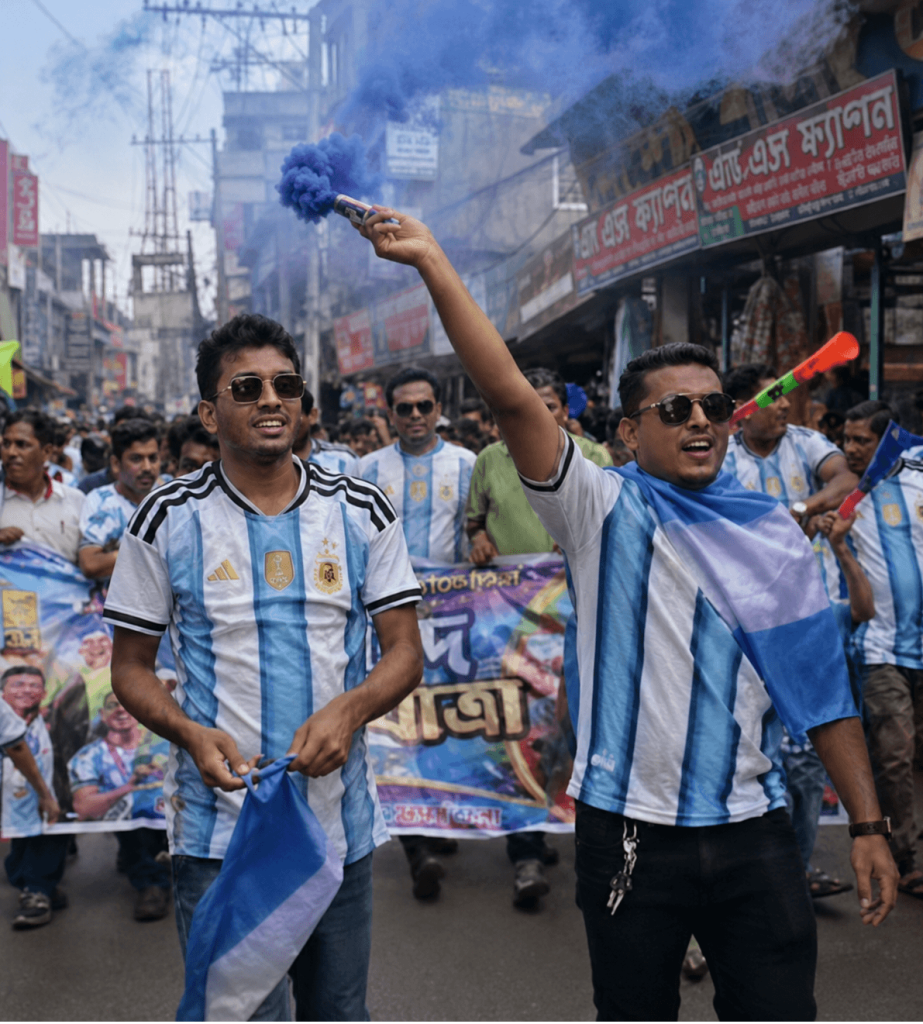
As Argentina prepared to face Spain in the World Cup final, thousands of miles from Buenos Aires, another sea of blue and white was forming across Bengal.
In Bangladesh, Argentine flags hung from rooftops and giant jerseys stretched between apartment buildings. Across the border in Kolkata, India, fans gathered before dawn around outdoor screens, wearing Lionel Messi’s No. 10 shirt and chanting his name in the Bengali cadence: “May-si.”
The devotion crosses a national boundary but draws from a shared Bengali history of football, colonial memory and admiration for players who appear capable of transforming a match through individual brilliance.
Neither Bangladesh nor India has played in a World Cup. Yet in both countries, Argentina has become something close to an adopted national team.
The New York Times reported that Bangladesh’s attachment to the tournament began when World Cup matches were first broadcast live in the country in 1982. Four years later, Diego Maradona’s performance in Argentina’s championship run turned casual interest into a lasting allegiance.
Maradona’s two goals against England in the 1986 quarterfinal carried particular significance for some viewers in a region once governed by Britain. His dribbling, creativity and defiance also offered a style of football that many Bengali supporters found more appealing than the structured play associated with European teams.
The passion passed from one generation to the next. Parents who watched Maradona introduced their children to Gabriel Batistuta, Juan Sebastián Verón and, eventually, Messi.
Messi’s rise transformed that inherited loyalty into a mass cultural phenomenon. Argentina’s defeat in the 2014 final brought heartbreak, but its 2021 Copa América victory and 2022 World Cup title gave supporters the celebration they had awaited for decades.
The Athletic reported that streets across Bangladesh have been decorated with murals, graffiti, kites and enormous flags during the 2026 tournament. Schools and universities have become gathering places, with student groups organizing free screenings on playing fields and campuses.
At Daffodil International University in Dhaka, organizers said crowds of 15,000 to 20,000 people attended some matches. Similar screenings appeared in smaller cities and villages, allowing residents of different ages and backgrounds to arrive by foot or rickshaw and join the crowd.
The celebrations have also reached the diplomatic level. Argentina reopened its embassy in Dhaka in February 2023, shortly after its victory in Qatar. Argentine officials acknowledged that the extraordinary response from Bangladeshi supporters had helped bring the two countries closer.
The relationship has become increasingly reciprocal. Images of Bangladeshi fans celebrating Argentina have circulated widely in Latin America, while Argentine supporters have displayed Bangladesh’s red-and-green flag during their own celebrations.
Argentina coach Lionel Scaloni thanked Bangladeshi supporters before the semifinal against England. Goalkeeper Emiliano Martínez has also expressed affection for the country’s fans.
In Kolkata, the attachment to Argentina grows from an even older football culture. The city is home to historic clubs including Mohun Bagan, Mohammedan Sporting and East Bengal, and its local rivalries have shaped generations of deeply knowledgeable supporters.
Al Jazeera reported that hundreds of fans gathered at a Kolkata park before sunrise to watch Argentina play Cape Verde, surrounding themselves with flags, loudspeakers and life-size images of the players. When Lisandro Martínez scored in extra time, the crowd erupted in celebration.
Kolkata was once more closely associated with Brazil. Pelé’s visit with the New York Cosmos in 1977 strengthened that connection, and Brazil’s expressive style appealed to supporters for decades.
Maradona changed the balance in 1986.
For many older fans, that tournament was the first time they had watched a global football star dominate matches live on television rather than reading about him afterward. Messi later inherited that affection, especially after leading Argentina to the 2022 championship.
In Kolkata neighborhoods, homes and tea stalls have been painted in Argentina’s colors. Families have cut enormous blue-and-white birthday cakes for Messi, distributed jerseys to children and named members of a new generation after him.
Brazil still commands a substantial following in both India and Bangladesh, and the rivalry between the two fan bases remains part of the World Cup experience. Supporters trade jokes, organize competing processions and decorate streets in opposing colors.
But Argentina’s run to another final has again shown how strongly its team resonates across Bengal.
The connection is not based on geography, citizenship or direct family ties. It is built through television memories, neighborhood gatherings and stories handed down from parents to children.
For Bengali supporters in Kolkata, Dhaka and countless communities between them, Argentina is not merely a distant team.
Every four years, it becomes part of home.