


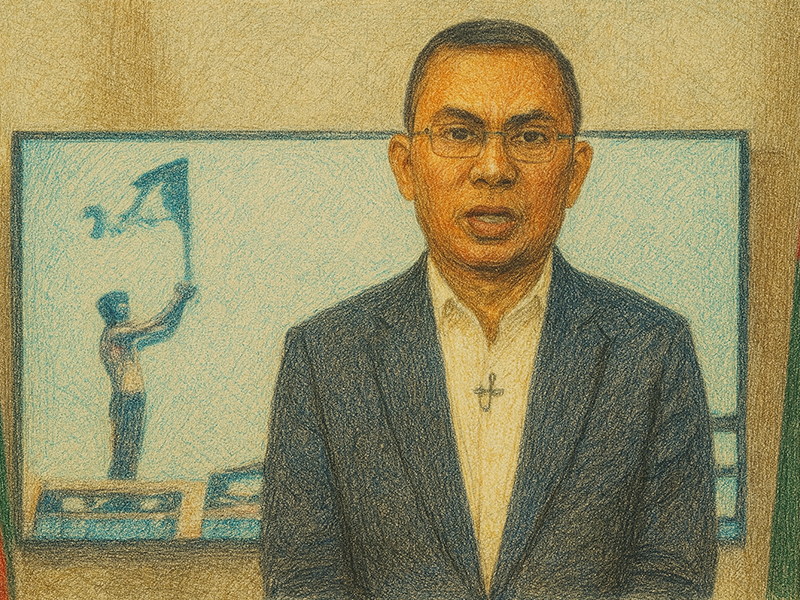
Tarique Rahman, acting chairman of the Bangladesh Nationalist Party (BNP), has once again addressed the nation from exile in the United Kingdom, calling for democracy, justice, and inclusivity in Bangladesh. But his renewed pledges arrive against the backdrop of a political legacy marked by corruption, authoritarianism, and a prolonged absence from the realities on the ground.
While thousands of Bangladeshis have mobilized in recent years, often at great personal risk, to demand political reform, Rahman has remained abroad, living in self-imposed exile in London since 2008. From this distance, he has continued to issue political statements, outlining sweeping reforms and vowing to end political violence. Yet critics and observers alike point to his past leadership role during the 2001 to 2006 BNP-led government as evidence that his words do not align with his record.
During that time, Rahman operated from Hawa Bhaban, the BNP’s political headquarters in Dhaka, which became an alternative center of power often described by diplomats and analysts as a “shadow government.” It was under this informal authority that Bangladesh experienced widespread corruption, political interference, and alleged abuse of state resources. Rahman was referred to in diplomatic circles as the “Dark Prince,” a reflection of the perception that he wielded disproportionate influence behind the scenes.
International watchdogs repeatedly raised concerns during the BNP’s tenure. Transparency International ranked Bangladesh as the most corrupt country globally for five consecutive years during that period. The World Bank withdrew support for several infrastructure projects, citing unresolved corruption risks. Reports from journalists, civil society organizations, and leaked U.S. diplomatic cables further documented a pattern of extortion, cronyism, and political repression.
Despite this history, Rahman now seeks to position himself as a reformist, recently introducing the vision of a “Rainbow Bangladesh.” But political analysts argue that branding exercises cannot substitute for accountability or a clear reckoning with past actions. For many, the contrast between Rahman’s rhetoric and his documented record remains stark.
Leadership in a democratic society requires more than remote declarations. It demands transparency, presence, and responsibility. With Rahman continuing to reside abroad and facing unresolved legal cases at home, questions persist about whether he can credibly represent a path forward for Bangladesh’s democratic aspirations.
As the country grapples with economic challenges, political uncertainty, and an increasingly active civil society, many argue that Bangladesh cannot afford a return to leadership models rooted in opacity and exclusion. For those invested in genuine democratic progress, the future likely lies beyond recycled promises and familiar figures.