


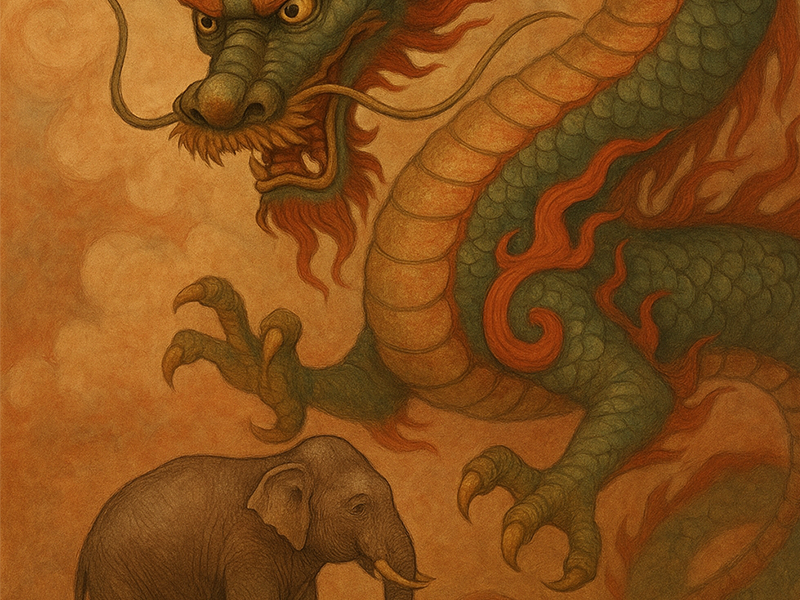
India once held a commanding presence in South Asia: economically, politically and culturally. But in recent years, it has watched its influence erode across the region. From Bangladesh and Nepal to the Maldives and Sri Lanka, the neighborhood is tilting steadily toward China. In response, India must act decisively and strategically. It must stop taking its neighbors for granted and start treating them as true partners. If it fails to do so, it risks strategic encirclement by Beijing, a scenario that would severely compromise India’s regional and global ambitions.
Nowhere is India’s decline more visible than in Bangladesh. For over a decade, the Awami League government under Sheikh Hasina was India’s closest partner in the region. Hasina’s government clamped down on Indian separatist groups and pushed for closer economic and security ties with Delhi. But her increasing authoritarianism and corruption triggered massive protests and, eventually, her ouster. The interim government led by Nobel laureate Muhammad Yunus has pivoted sharply toward China, securing promises of billions in infrastructure investment. Anti-India sentiment, once suppressed, is now openly expressed, and India’s decision to offer asylum to Hasina has only fueled public resentment.
The story is similar in the Maldives. Mohamed Muizzu, who won the presidency on a populist “India Out” campaign, has since doubled down on his pro-China orientation. His party recently swept parliamentary elections, giving him a firm mandate to pursue deeper economic and strategic ties with Beijing. Indian military personnel were asked to leave. Meanwhile, China has rekindled discussions on a long-stalled free trade agreement and gained growing access to key Indian Ocean shipping lanes through the archipelago.
Nepal, too, has tilted back toward Beijing. Prime Minister K.P. Sharma Oli, a vocal communist and critic of India, has restarted joint military exercises with China and welcomed renewed Belt and Road Initiative funding. Tellingly, he broke diplomatic tradition by visiting Beijing before making any official visit to Delhi. In Sri Lanka, although the new left-leaning government signed a defense agreement with India, it has made clear its economic and ideological preferences lie with China. It held a pro-China rally with Chinese Communist Party guests and has promoted China’s development model over India’s.
Each of these developments on its own might be dismissed as circumstantial or politically driven. Taken together, however, they form a dangerous pattern: India’s regional leadership is collapsing while China is rapidly filling the vacuum with money, diplomacy and strategic influence. This is not just a diplomatic failure; it is a threat to national security. China’s strategy of encirclement is not theoretical. It is operational. With ports in Pakistan (Gwadar), Sri Lanka (Hambantota) and potentially in the Maldives, along with military exercises in Nepal and growing influence in Bangladesh, China is boxing India in. In a time of crisis, this could significantly constrain India’s freedom to maneuver.
There is, however, a way forward, and it begins with humility and regional cooperation. Bangladesh has recently expressed interest in reviving the South Asian Association for Regional Cooperation, a body that has long been sidelined due to tensions between India and Pakistan. India should embrace this opportunity, not resist it. Supporting SAARC’s revival would signal that India is serious about regional cooperation and no longer views its neighbors as junior partners. It would also undercut China’s narrative that India is an unreliable hegemon.
India must also reinvest in its “Neighborhood First” policy, not just in rhetoric but in substance. That means offering infrastructure support that is timely, transparent and accountable. It means creating regional economic frameworks that benefit all parties rather than being seen as vehicles for Indian dominance. And it means addressing legitimate grievances from smaller nations rather than brushing them aside. Countries like Nepal and the Maldives may be small in population, but in the geopolitical balance of the Indian Ocean, their allegiance is critical.
A key area where India can lead is climate adaptation and disaster resilience. South Asia is one of the world’s most climate-vulnerable regions. India has the technological and logistical capacity to position itself as a regional hub for disaster response, early warning systems and renewable energy development. Doing so would not only save lives; it would build trust and goodwill.
Cultural diplomacy, too, should not be neglected. India has deep cultural, linguistic and historical ties with its neighbors that China cannot replicate. Reviving educational exchanges, promoting regional tourism and supporting diaspora engagement can foster bonds that go beyond transactional economics.
To be clear, India will not outspend China. But it does not have to. What India can offer is something more valuable: partnership based on trust, shared history and mutual respect. That means ending the habit of condescension and embracing a more equitable model of diplomacy, one that listens as much as it lectures.
In the end, India’s aspirations to be a global power hinge on whether it can command respect and trust in its own backyard. Global influence begins at home. And right now, home is slipping away. If India wants to avoid being encircled and reclaim its standing in South Asia, it must act through diplomacy, humility and smart investment — before it is too late.