


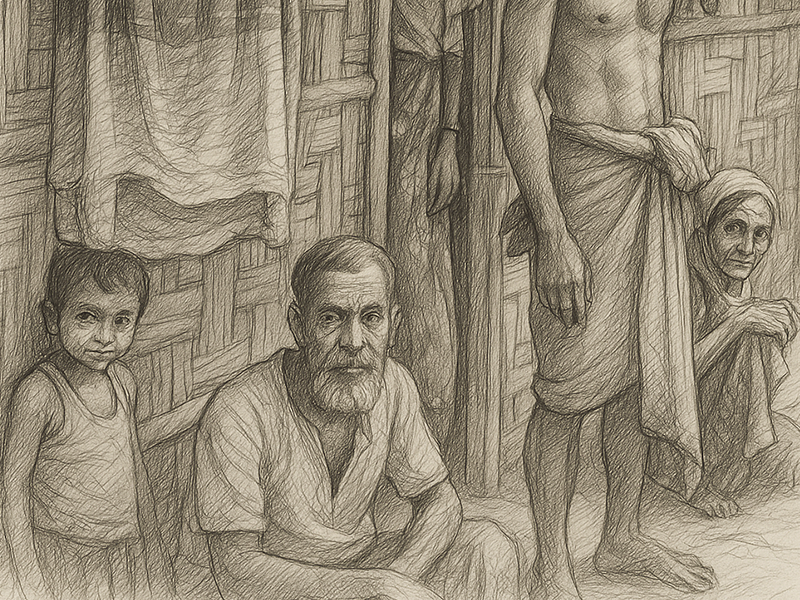
As Bangladesh recalls its ambassador from Myanmar and flirts with backchannel talks with the Arakan Army, a rebel group fighting the Myanmar junta, an old geopolitical question gains new relevance: Should Bangladesh consider formally absorbing Arakan — historically known as Arakan and now called Rakhine State — and integrate it as a province?
It’s not a fringe idea. Bangladesh already hosts more than 1.5 million Rohingya refugees, most of whom fled brutal military campaigns in Myanmar’s Rakhine State. For years, Dhaka has sheltered, fed, and protected this population with limited international support and diminishing prospects of repatriation. If Bangladesh is already de facto administering humanitarian support to a displaced population from Arakan, does it not make strategic sense to consider a de jure realignment of borders?
Historically, Arakan has seen fluctuating sovereignties. It was an independent kingdom until 1785, when it fell to the Konbaung dynasty — the last royal Burmese regime before British colonization. That annexation ended centuries of independent or semi-autonomous rule, often influenced more by Bengal than central Burma. Some might argue that reversing that annexation would correct a historical injustice.
The cultural and political bonds between Bengal and Arakan go deep. In 1430, the Arakanese king Narameikhla regained his throne with military help from Bengal. As a sign of fealty and alliance, he ceded territory and adopted Islamic court customs, including the use of Persian titles and Bengali coinage. This was not forced assimilation but an era of dynamic cultural syncretism, where Bengali Muslims, Arakanese Buddhists, and foreign traders coexisted in cities like Mrauk U and Chittagong. Those crosscurrents left an enduring legacy of pluralism and cultural blending that contradicts the monolithic nationalism now imposed by Myanmar’s military state.
The failure of Myanmar’s junta to repatriate the Rohingya population further strengthens the case. Not only has the junta refused meaningful negotiations, it continues military operations that worsen conditions in Rakhine. The United Nations warns of famine, and Bangladesh reports over 130,000 new arrivals in the past year alone. Meanwhile, the former Sheikh Hasina government’s attempts at diplomacy — often cautious and reactive — yielded little.
This week, that diplomatic patience appears to have worn thin. Dhaka’s recall of its ambassador from Naypyidaw, described as an “administrative decision,” coincides with unofficial talks between Bangladesh and the Arakan Army. That rebel group seeks autonomy or independence for Rakhine. The opening of communication channels could signal the beginning of a paradigm shift — one that aligns more with ground realities than with legacy boundaries.
Strategically, absorbing Arakan would be a bold move. It would likely be condemned internationally and would provoke a fierce response from the Myanmar junta. Yet, Myanmar itself is rapidly fragmenting. Ethnic armed groups are controlling swaths of territory, and the central authority is weakened. Bangladesh, a relatively stable and cohesive state, might find in Arakan not just a security buffer but an extension of shared historical and cultural ties.
This is not to romanticize annexation or overlook the deep complexities of regional geopolitics. But with each passing year, the “temporary” sheltering of over a million Rohingya becomes more permanent, while the cost — economically and diplomatically — mounts. If Myanmar will not solve the problem, and the international community offers only tepid support, is it not time for Bangladesh to consider a solution that puts control in its own hands?
The question of absorbing Arakan is provocative, no doubt. But it may soon become less a question of “if” and more one of “how.”