


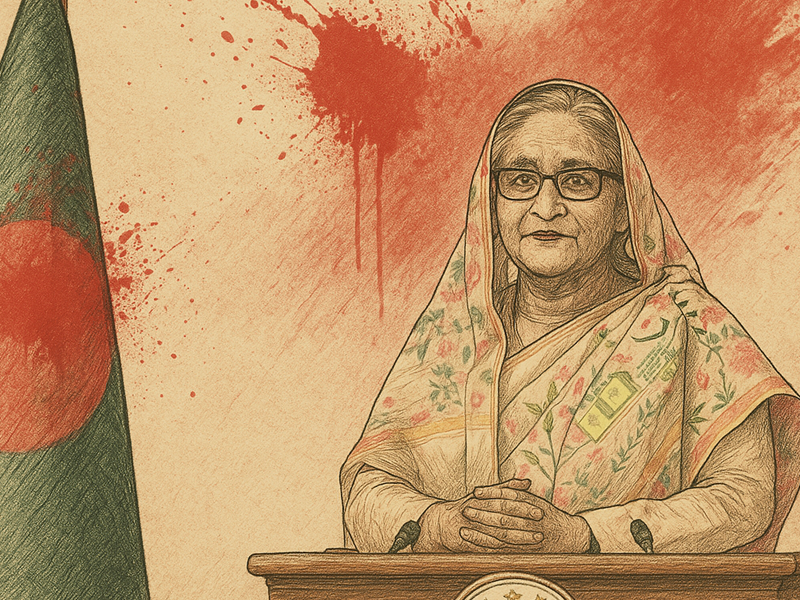
Former Bangladesh prime minister Sheikh Hasina has refused to accept personal responsibility or apologize to the families of people killed during the violent suppression of the July-August 2024 uprising, arguing that police acted independently under established procedures.
Asked by The Hindu whether she accepted responsibility for hundreds of deaths during police action allegedly ordered by her, Hasina rejected the premise.
“When police are working in the field, how can they contact the Prime Minister for every action?” Hasina said. “Police operate under standard operating procedures. They are trained to handle emergencies, crowd control and violent situations.”
She said officers responded after police personnel were attacked and killed and police stations were set on fire.
“How could I personally order officers in those circumstances?” she said.
Her denial comes despite evidence gathered since her government fell that directly challenges her assertion that she did not personally authorize the use of lethal force.
A leaked recording of a July 18, 2024, telephone conversation, authenticated by BBC Eye, captures Hasina saying she had given instructions allowing security forces to use lethal weapons against protesters. In the recording, she says forces would shoot protesters “wherever they find them.” Audio forensic specialists found no evidence that the recording had been manipulated or synthetically generated, while Bangladesh police matched the voice to verified recordings of Hasina.
The United Nations Office of the High Commissioner for Human Rights (OHCHR) reached broader conclusions about responsibility for the crackdown after conducting an extensive investigation.
The U.N. estimated that as many as 1,400 people were killed between July 1 and Aug. 15, 2024, with thousands more injured. It said the vast majority of those killed were shot by Bangladesh security forces. Children may have accounted for 12% to 13% of the deaths.
The U.N. found reasonable grounds to believe Hasina’s government, security and intelligence agencies, and violent elements associated with the Awami League systematically committed serious human rights violations. Investigators found evidence of an official policy to attack and violently repress anti-government protesters and said former senior officials described how Hasina and other senior leaders directed and oversaw large-scale security operations.
U.N. human rights chief Volker Türk said there were reasonable grounds to believe hundreds of extrajudicial killings, arbitrary arrests, detentions, and torture occurred with the “knowledge, coordination and direction” of the political leadership and senior security officials.
Hasina, however, turned the question of an apology back on her opponents, citing attacks on police, Awami League members, public buildings, and others during and after the uprising.
“Have they apologised? No,” she told The Hindu. “So, who should apologise?”
Hasina also alleged that thousands of Awami League workers had subsequently been killed, disappeared, arrested, or had their homes attacked, and accused the government led by Muhammad Yunus of failing to protect her supporters.
Those allegations do not alter the U.N.’s findings about the actions of Hasina’s government during the uprising. The U.N. report also documented retaliatory violence against police officers, Awami League members, and others after the government’s collapse, while separately concluding that the former government carried out a coordinated campaign of violent repression against protesters.
Hasina fled Bangladesh on Aug. 5, 2024, as the uprising brought an end to her government. She has remained in India under the protection of Prime Minister Narendra Modi’s government.
Have a question?
This feature is in beta. AI can make mistakes, so please verify important details.
5 free questions remaining.
Technical details
Join Deshweek Premium for unlimited article Q&A.
Join Deshweek Premium Sign in