


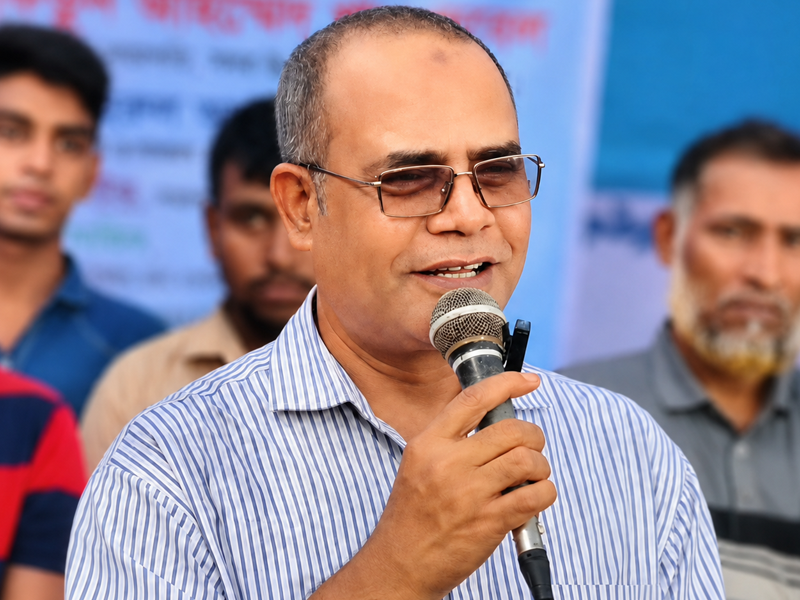
Maftun Ahmed Khan Rubel should withdraw his complaint against Gazi Salahuddin Tanvir.
Filing a police complaint because someone insulted Prime Minister Tarique Rahman is not a defense of democracy, political stability or national sovereignty. It is an act of political intimidation by a party leader who appears to believe the prime minister’s personal dignity deserves greater protection than a citizen’s freedom to speak.
It does not.
Tanvir’s Facebook post was crude, provocative and insulting. He appeared to question Rahman’s parentage and used language many people would find offensive. But free speech does not exist only for respectable opinions, carefully chosen words or statements approved by those in power.
Free speech is absolute.
It must protect the vulgar, the offensive, the reckless and the unpopular. Otherwise, it is not a right. It is merely permission granted by the powerful and withdrawn whenever they feel insulted.
Bangladesh’s Constitution guarantees freedom of thought and conscience. It guarantees every citizen the right to freedom of speech and expression. Those words should mean something, especially when the speech is directed against the head of government.
Rubel’s complaint makes a mockery of that protection.
He is not an ordinary citizen quietly objecting to a personal insult. He is the president of the Bogura Sadar unit of the Bangladesh Nationalist Party, the party led by the man whom Tanvir criticized. His decision to involve police sends a threatening message far beyond one deleted Facebook post: criticize the prime minister harshly enough, and ruling-party officials may bring the state to your door.
That is not democratic accountability. It is an abuse of political influence.
Rubel should have responded with words. He could have condemned Tanvir’s language, defended Rahman’s family history, challenged the post’s accuracy or demanded an apology. Instead, he filed a complaint alleging that a Facebook insult damaged the prime minister’s reputation, caused public outrage and threatened national stability and sovereignty.
That claim is absurdly inflated.
A vulgar Facebook post is not a threat to Bangladesh’s sovereignty. An insult aimed at a prime minister is not an attack on the state. Rahman is a politician, not the nation itself. Confusing criticism of a leader with hostility toward the country is one of the oldest and most dangerous habits of authoritarian politics.
Rubel should know better.
The fact that Tanvir deleted the post proves nothing about whether it was wrong. Deletion is not a confession. It is not evidence that the post was defamatory, unlawful or morally indefensible.
People delete posts because they fear arrest. They fear losing their jobs. They fear retaliation from political parties, police, mobs or government supporters. They may decide that maintaining a Facebook post is not worth risking their safety.
When a ruling-party leader files a police complaint, investigators announce that the allegation has preliminary merit and the speaker’s party suspends him, deleting the post may be evidence of fear rather than remorse.
Rubel cannot help create that fear and then treat the resulting silence as vindication.
In the United States, Americans direct far more serious accusations at President Donald Trump. Citizens, commentators and politicians have called him a rapist, a felon and a protector of pedophiles. Trump and his supporters fiercely dispute some of those descriptions, but the speakers are not generally treated as enemies of the state merely for saying them.
American political speech is often vicious, personal and indecent. That is precisely why its protection matters.
A democracy does not collapse because its leader is insulted. It begins to collapse when political officials decide that insults must be answered with police complaints.
Rubel is also not the first Bangladesh Nationalist Party leader to display a disturbing inability to understand free speech.
State minister for liberation war affairs Ishraque Hossain recently led a torchlight procession after National Citizen Party leader Nasiruddin Patwary criticized Rahman’s leadership and the government’s response to political violence.
Patwary’s offense was political criticism.
Hossain could have answered him. He could have defended the government’s record, challenged his accusations or exposed factual errors. Instead, he joined a street demonstration defending the honor of his party leader and warned of stronger action.
That response was foolish, theatrical and unworthy of a government minister.
Hossain is young, but youth is no excuse for constitutional carelessness.
Born in 1987, he is an engineer, a lawmaker, a Bangladesh Nationalist Party politician and a state minister. Those distinctions should come with a heightened understanding of democratic rights, not a diminished tolerance for criticism.
A younger minister should represent a political generation prepared to reject leader worship and coercive party culture. Instead, Hossain appeared to embrace the old instinct that criticism of the leader must be treated as an offense against the party and the nation.
Now Rubel is repeating that mistake through the police.
The two episodes are part of the same dangerous pattern. One party leader organizes a torch procession because the prime minister was criticized. Another files a complaint because the prime minister was insulted. Both behave as though Rahman’s honor is a public institution requiring enforcement.
It is not.
Rahman is the prime minister. Criticism comes with the office. So do ridicule, mockery, accusations, personal attacks and language he may consider deeply unfair.
The more powerful a politician becomes, the less protection he should expect from offensive speech. Power brings scrutiny. It brings resentment. It brings insults. A political leader who cannot tolerate those things is not prepared for democratic government.
Rahman’s supporters are free to condemn Tanvir. They are free to call the post disgraceful, dishonest or obscene. They are free to persuade the public that Tanvir acted irresponsibly.
They are not entitled to use political influence and police authority to frighten him into silence.
Free speech is not measured by how comfortably it protects praise. It is measured by whether it protects a citizen who says something ugly about the most powerful person in the country.
Rubel has failed that test.
Hossain failed it before him.
Both men should stop behaving like personal guardians of Tarique Rahman’s honor and begin acting like public officials and political leaders operating under a Constitution that guarantees citizens the freedom to speak.
A prime minister’s reputation must be defended through performance, evidence and public debate.
Not torch processions.
Not police complaints.
Not fear.