


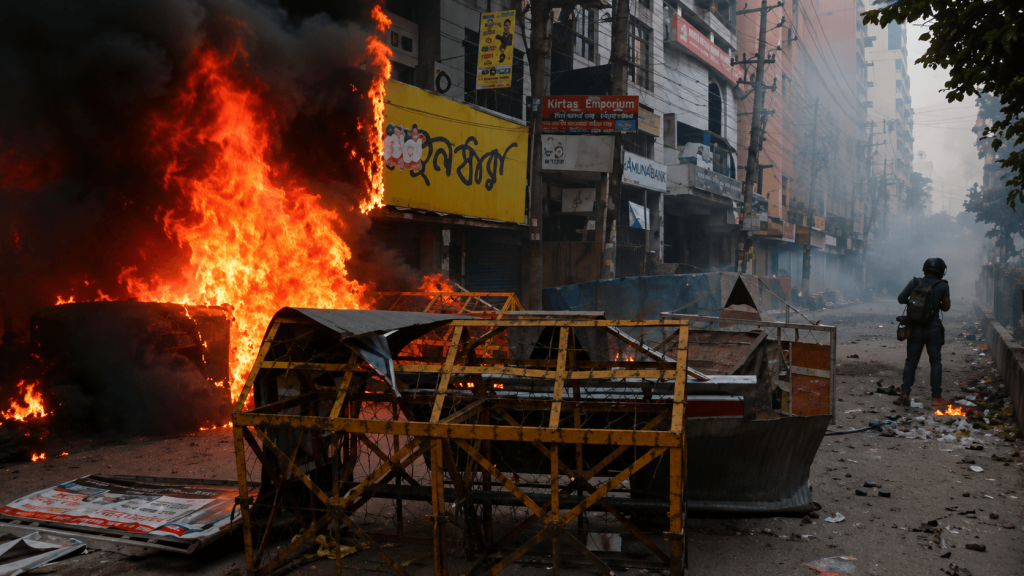
The Shapla Chattar killings refer to a deadly security operation carried out in Dhaka on the night of May 5 and the early hours of May 6, 2013, when police and other security forces dispersed thousands of supporters of Hefazat-e-Islam from the capital’s commercial district.
The incident, also known by security forces as Operation Flash Out, remains one of Bangladesh’s most disputed political and human rights cases. More than a decade later, it is the subject of an investigation by the International Crimes Tribunal.
Who was protesting?
The demonstration was organized by Hefazat-e-Islam, a conservative Islamic advocacy group composed largely of teachers and students from madrassahs, or Islamic religious schools.
The group marched into Dhaka to press the government to adopt a 13-point charter that included calls for a blasphemy law, punishment for bloggers accused of insulting the Prophet Muhammad, and restrictions on the public mixing of men and women.
What happened on May 5, 2013?
An estimated 200,000 Hefazat supporters entered Dhaka on May 5.
During the day, clashes erupted between protesters, police and activists from the ruling Awami League. Protesters threw bricks, torched vehicles and damaged buildings, while police used tear gas and rubber bullets to disperse crowds.
By nightfall, most demonstrators had left the capital, but an estimated 50,000 to 70,000 people remained gathered at Shapla Chattar, where many were praying, listening to speeches or sleeping.
How did the crackdown unfold?
According to witness accounts and subsequent investigations, the operation began after authorities cut electricity to the area at about 1:45 a.m. on May 6.
Around 2:30 a.m., a joint force of police, the Rapid Action Battalion and Border Guard Bangladesh moved into the square from multiple directions, using tear gas, sound grenades and rubber bullets to clear the area.
The government maintained that the operation was controlled and largely non-lethal.
However, human rights organizations, journalists and eyewitnesses alleged that security forces also used live ammunition and shotgun pellets against protesters. Witnesses reported that some fleeing protesters were pursued into nearby streets and buildings and that some injured demonstrators were beaten or shot after the initial assault. Those allegations have been denied by successive governments.
How many people were killed?
The death toll has remained one of the most contested aspects of the incident.
Government officials initially said there were no deaths during the overnight operation and later said 11 or 12 people were killed, most during daytime clashes.
Hefazat-e-Islam and opposition figures alleged that between 1,000 and 3,500 people were killed and that bodies were secretly removed from the scene, claims that have not been independently verified.
Independent investigations reached lower figures. Human Rights Watch concluded that at least 58 people died during the events of May 5 and 6 based on hospital records and witness testimony. Bangladeshi human rights organization Odhikar documented and published a list of 61 victims. In 2025, Hefazat-e-Islam released its own list naming 93 people it said had been killed.
The International Crimes Tribunal’s investigation has identified 61 deaths, with investigators saying they have positively identified 58 of the victims.
What happened after the operation?
During the overnight operation, authorities ordered Diganta TV and Islamic TV off the air while they were broadcasting live coverage of the crackdown.
Human rights groups also reported that authorities carried out arrests of suspected protesters in the days that followed and alleged that victims’ families faced intimidation. Previous governments rejected allegations that they had sought to suppress information or evade responsibility.
Why is the case back in the news?
Following the political upheaval that led to the fall of Sheikh Hasina’s government in 2024, Bangladesh’s International Crimes Tribunal opened a formal investigation into the events.
Prosecutors have said the investigation alleges that then-Prime Minister Sheikh Hasina ordered the operation and have named her as the principal accused in a draft investigation report. Hasina has denied wrongdoing in other cases, and the allegations are expected to be tested through judicial proceedings.
In October 2025, the interim government announced financial assistance for families of those killed and said it would build a memorial at Shapla Chattar to commemorate the victims.
As of July 2026, prosecutors say they are preparing to file formal charges before the tribunal, marking the next stage in the legal process.