


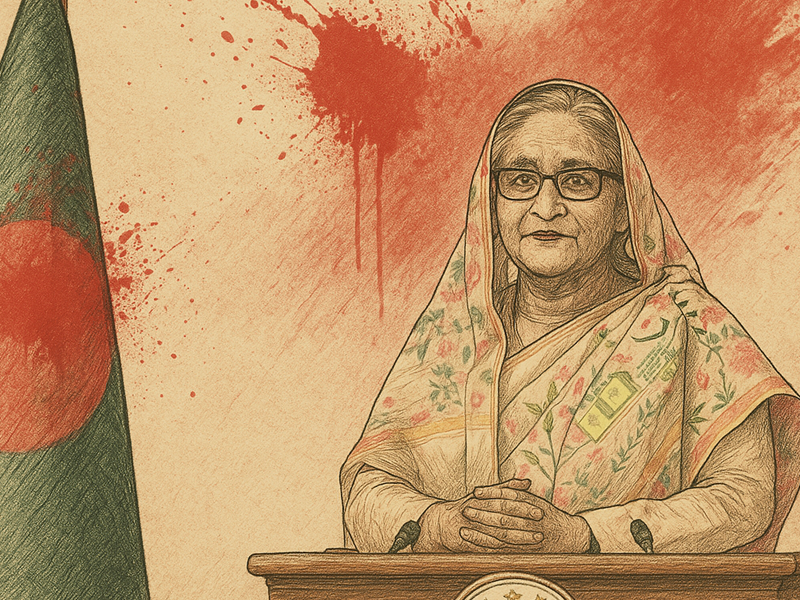
Bangladesh’s deposed prime minister Sheikh Hasina was sentenced to death Monday after a war-crimes tribunal found her guilty of orchestrating a state-directed campaign of killings, torture and the burning of bodies during last year’s July uprising. The International Crimes Tribunal ruled that Hasina, 78, ordered lethal force, including drones, helicopters and live ammunition, against unarmed student protesters demanding civil-service quota reforms. UN investigators estimate that the crackdown resulted in up to 1,400 deaths between July 1 and August 5, 2024.
Hasina was convicted on five counts of crimes against humanity under the International Crimes Tribunals Act, 1973. The charges included ordering mass killings, the murder of Begum Rokeya University student Abu Sayed, directing the shooting of six unarmed protesters in Dhaka’s Chankharpul on August 5, and coordinating the killing and burning of six student demonstrators in Ashulia the same day. Prosecutors also presented evidence that state forces and ruling-party cadres burned victims after death and in one case allegedly while the person was alive in an effort to destroy evidence. The tribunal said the crimes constituted a joint criminal enterprise overseen by Hasina.
Former home minister Asaduzzaman Khan Kamal was also sentenced to death and remains a fugitive. Former police chief Chowdhury Abdullah Al-Mamun received five years after pleading guilty and becoming the tribunal’s first state witness since its creation in 2010. Judges ordered the confiscation of property owned by Hasina and Asaduzzaman.
Hasina, now in India, rejected the verdict as biased and politically motivated. She told Reuters she is not afraid to face her accusers in a proper tribunal where evidence can be weighed and tested fairly. She has denied all charges and called the tribunal a kangaroo court.
Under Bangladeshi law, Hasina has an automatic right to appeal to the Appellate Division of the Supreme Court. The appeal must be filed within 30 days and the court must issue a decision within 60 days, which is the only legal remedy available. She also faces three additional tribunal cases, including two involving enforced disappearances and one tied to alleged mass killings at Motijheel’s Shapla Chattar in 2013.
The verdict, which was the tribunal’s first ruling on atrocities committed during the uprising, was delivered amid a four-layer security lockdown around the court, with army, Border Guard Bangladesh and police restricting movement across central Dhaka.