


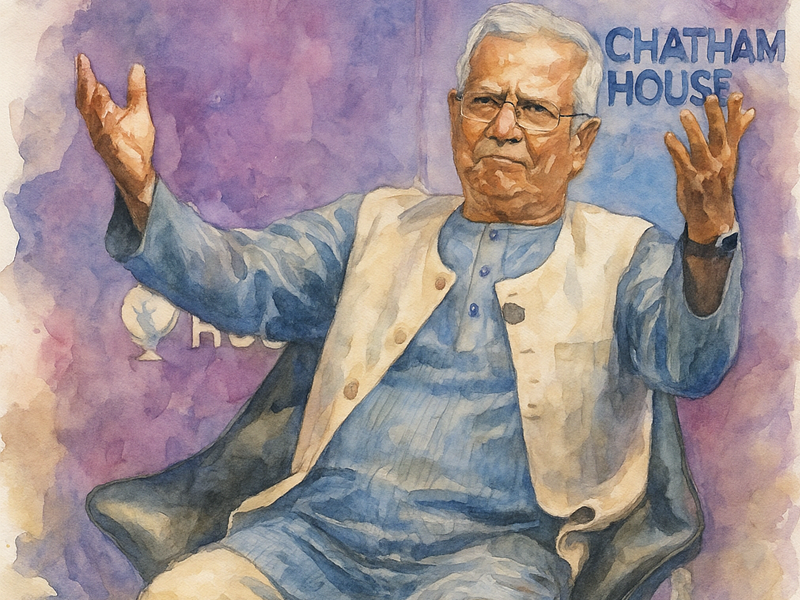
Muhammad Yunus, Bangladesh’s interim leader and once a global symbol of peace and progress, must urgently reorient his government away from authoritarian tactics and toward true democratic reform. The promise made after the fall of Sheikh Hasina’s government to restore rights and rebuild a democratic foundation cannot be fulfilled through repression, censorship, and political exclusion. It is imperative that Yunus fix his approach and uphold the rights of all Bangladeshis, regardless of their political affiliation.
The recent actions by the interim government paint a disturbing picture of continuity rather than change. On May 12, authorities imposed a sweeping ban on the Awami League, the same party whose abuses under Hasina sparked mass protests and eventually led to her removal from power. This move, enabled by a troubling amendment to the Anti-Terrorism Act, prohibits virtually all political expression in support of the Awami League, including speech, online posts, peaceful gatherings, and even publications. The Election Commission followed up by stripping the party of its registration, effectively erasing the political rights of millions of citizens.
This is not reform. It is repression by another name.
Human Rights Watch has rightly warned that banning speech and association based on political affiliation violates fundamental freedoms. The new provisions of the International Crimes (Tribunals) Act dangerously expand the government’s ability to prosecute organizations and individuals based on vague accusations of “support” for banned entities. These overly broad definitions create a chilling effect, empowering the state to detain or silence anyone remotely associated with the opposition, including actors, lawyers, singers, and ordinary citizens. This is not how a free society operates.
The new legislation to address enforced disappearances, a crime for which the previous regime was widely condemned, also fails to meet international standards. The draft law weakens the principle of command responsibility and omits most of the very cases it should address. Crucially, it excludes “widespread or systematic” enforced disappearances from the jurisdiction of the proposed tribunal, effectively shielding the gravest abuses from justice. If the Yunus government genuinely seeks accountability, then these loopholes must be closed, not codified.
What’s more, the government has not integrated the findings of its own commission of inquiry into the legislative process. The commission has already documented 1,676 cases of disappearance, with at least 200 individuals still missing. This evidence is not just relevant. It is essential. The failure to use it not only undermines the rule of law but prolongs the suffering of the victims’ families, who have waited years for answers.
The government’s current trajectory undermines its legitimacy. Justice cannot be selective. Rights cannot be conditional. If Yunus’s administration continues to silence dissent and sideline political rivals, it risks replicating the very abuses it claims to dismantle. Even if the Awami League is guilty of past crimes, its supporters retain the full protection of law and international human rights norms. Denying them that protection discredits the government’s reform agenda and threatens to entrench a new cycle of authoritarianism.
Yunus must abandon this strategy of collective punishment. Instead, he should reaffirm his commitment to holding individuals accountable for specific crimes through fair trials, not mass detentions or blanket bans. That means reversing the suppression of political speech, lifting the ban on the Awami League’s activities, and focusing on evidence-based prosecutions.
The path forward lies in justice, not vengeance. If Bangladesh is to turn the page on decades of repression, the interim government must lead by example. That starts with Yunus fixing course immediately and proving that the promise of rights and reform was more than just words.