


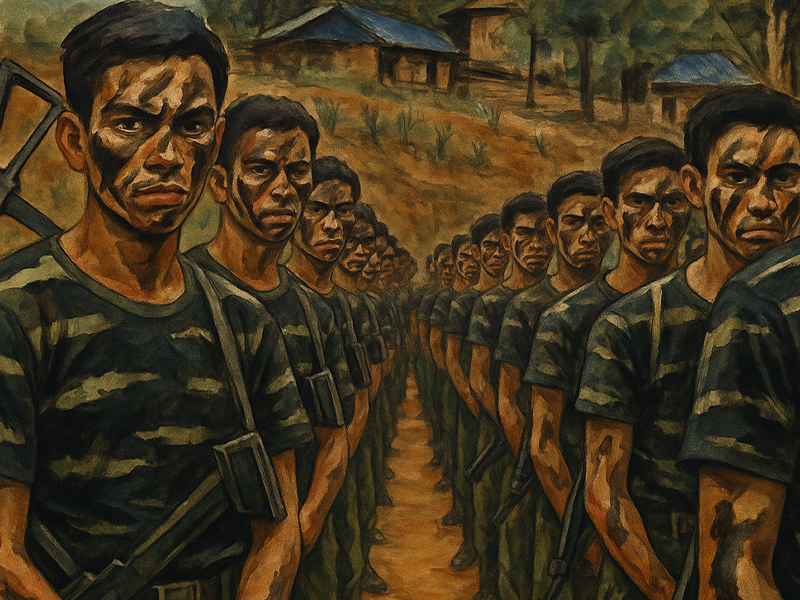
Analysts say the Arakan Army (AA), a powerful non-state armed group operating in Myanmar’s Rakhine State, has emerged as a significant threat to regional stability and Bangladesh’s national security since taking control of nearly the entire Myanmar border with Bangladesh in late 2024.
The Arakan Army, led by Twan Mrat Naing, is accused by multiple human rights organizations of targeting Rohingya civilians in Rakhine through killings, arbitrary detentions, and forced displacement. Following intensified fighting in November 2023, the AA has expanded its control to 14 of 17 Rakhine townships and now oversees 271 kilometers of the Myanmar-Bangladesh border. The United Nations estimates more than 118,000 Rohingya have crossed into Bangladesh since Operation 1027 began, fleeing violence and fear of further persecution.
Security experts warn the AA’s ethno-nationalist ideology, rooted in the goal of establishing an independent and homogeneous Rakhine State, has exacerbated tensions. The group has often referred to the Rohingya as “Bengali terrorists” and has maintained an ambiguous stance on their status, mirroring rhetoric used by Myanmar’s former ruling military. The growing hostility between the AA and Rohingya groups — some of whom are reportedly cooperating with Myanmar’s junta forces — has deepened the humanitarian crisis and further complicated prospects for Rohingya repatriation.
Along the border, the AA has been implicated in abductions and shootings of Bangladeshi fishermen near the Naf River and Saint Martin’s Island, creating fear and disrupting local economies. The group’s alleged demands for commissions on cross-border trade have alarmed traders, while repeated cross-border gunfire has raised concerns over territorial integrity. Weak border security infrastructure has enabled AA fighters to reportedly enter Bangladesh during local festivals, heightening security concerns in southeastern districts.
Regional analysts say the AA’s activities are also linked to broader insurgency dynamics. The Bangladesh Army continues to monitor the Chittagong Hill Tracts (CHT), where local armed groups have in the past received support from Myanmar-based actors. Recently, the rise of the Kuki Chin National Front (KNF), operating near the Bandarban district, has raised fears of cross-border collaboration with the AA, potentially threatening the fragile peace in the region.
Some experts point to the AA’s growing military capabilities, its capture of weapon stockpiles, and its establishment of parallel governance structures as signs of increasing autonomy. The group has also taken control of territories historically connected to the Arakanese Kingdom, including parts of Myanmar’s Chin State adjacent to Bangladesh, fueling concerns about possible territorial ambitions in the CHT and greater Chittagong regions.
International observers note the involvement of external powers, including China and India, in Rakhine’s evolving landscape. The AA has expressed support for major infrastructure projects backed by both countries, and has recently called for foreign investment in the areas it controls. Experts caution that such developments risk further legitimizing the AA and complicating Bangladesh’s ability to negotiate security and humanitarian issues.
Security analysts advise the government in Dhaka to conduct proactive threat assessments and take decisive action to neutralize the AA’s influence along the border. They argue this is necessary to prevent further Rohingya displacement, maintain Bangladesh’s territorial integrity, and avoid the resurgence of cross-border insurgencies. The growing humanitarian crisis, coupled with shrinking international aid for refugees, underscores the urgency of stabilizing the border region.
Bangladesh’s security planners are urged to coordinate closely with regional partners, strengthen border surveillance, and prepare contingency strategies to address the ongoing and emerging threats posed by the Arakan Army.