


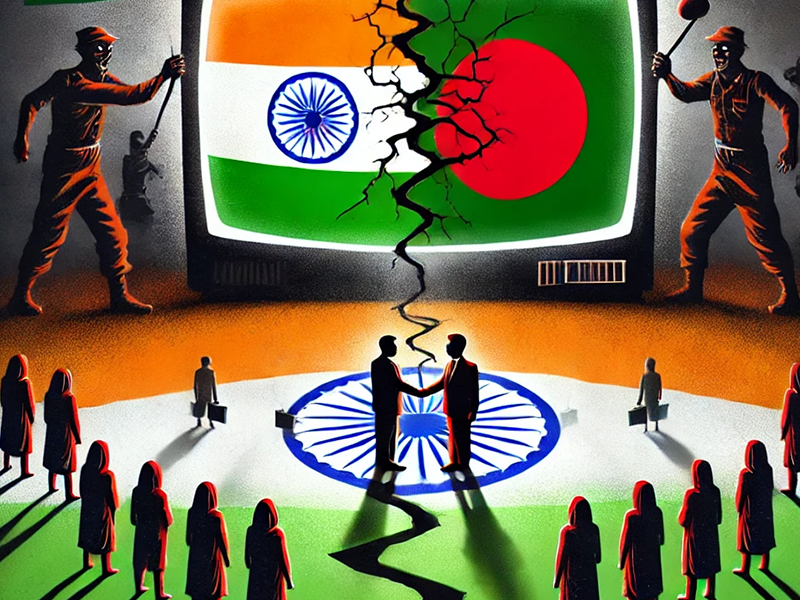
Bangladesh’s interim government head said this week that fake news from Indian media outlets is fueling tension between the two countries, undermining efforts to build stable relations.
Muhammad Yunus told a London audience on Wednesday that although his government seeks good relations with India, misinformation has repeatedly interfered with diplomatic progress.
“But somehow things go wrong every time because of all the fake news coming from the Indian press… and many people say it has connections with policymakers on the top,” Yunus said during a discussion at Chatham House. “This is what makes Bangladesh very jittery, very, very angry.”
He cited the example of former Prime Minister Sheikh Hasina using social media to address supporters in Bangladesh while in India — broadcasts that he said intensified public anger and political unrest back home. Yunus said he raised this issue directly with Indian Prime Minister Narendra Modi and was told that Hasina’s online activity could not be controlled.
“It’s an explosive situation, you can’t just walk away by saying it’s the social media,” he said.
The ongoing challenges underscore the difficulty governments face in regulating cross-border digital content. As major platforms struggle or decline to police themselves, some experts have suggested that Bangladesh could explore the development of a sovereign internet — a national framework designed to give governments more control over internet infrastructure, data flows, and platform accountability within their borders.
Such a system could potentially offer Bangladesh tools to limit the impact of destabilizing online activity, particularly from foreign-based accounts and media sources. Advocates of the idea point to past failures by platforms like Facebook, which played a documented role in spreading hate speech and inciting violence during the Rohingya crisis in Myanmar — events that led to a mass influx of refugees into Bangladesh.
Sheikh Hasina was ousted from power on Aug. 5, 2024, after widespread student protests. She now faces multiple legal cases in Bangladesh and remains abroad. Her presence in India and continued political messaging have become flashpoints between the two countries.
Yunus, who leads a transitional government formed in August 2024, said national elections are planned for the first half of 2026. He ruled out participating in the elected government.
During his visit to the United Kingdom, Yunus also met with British officials and faced demonstrations from supporters of Hasina’s Awami League party.