


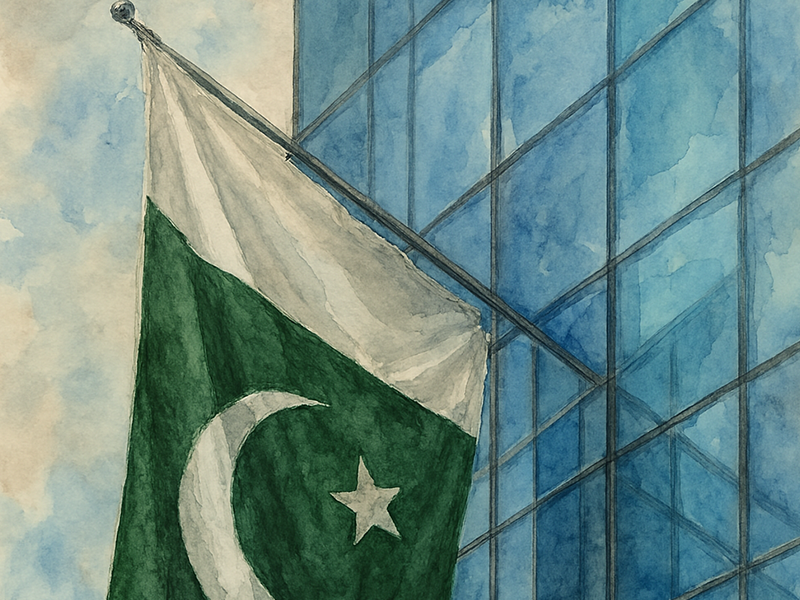
Just two years ago, Pakistan’s economy teetered on the brink of collapse. Inflation neared 40 percent, the country faced a near-default on its sovereign debt, and foreign reserves fell below $7 billion. Today, the narrative is changing. Backed by a $7 billion stabilization deal with the International Monetary Fund and a sweeping set of domestic reforms, Pakistan appears to be steering out of crisis and earning international recognition in the process.
The turnaround began after a turbulent 2022 and 2023, when catastrophic flooding, surging oil prices, and political instability shook the country. In response, the State Bank of Pakistan raised interest rates from 10 percent to 22 percent and implemented strict monetary policies. That strategy forced a recession but helped bring inflation under control. By April 2025, inflation dropped to just 0.3 percent, according to the Ministry of Finance.
The IMF agreement, signed in September 2023, provided both financial support and a framework for reform. More than $2 billion of the total $7 billion program has already been disbursed. Meanwhile, key creditors including China, Saudi Arabia, and the United Arab Emirates rolled over existing loans, providing additional breathing room.
Investor sentiment has shifted. The Karachi Stock Exchange index has tripled since early 2023. Pakistan’s Eurobonds due in 2031 climbed from 40 cents to 80 cents on the dollar, and the country’s credit ratings were upgraded by both Fitch and Moody’s.
Gross domestic product grew by 2.68 percent in fiscal year 2024–25, with industrial activity rebounding by 4.8 percent, according to the Economic Survey of Pakistan. Finance Minister Muhammad Aurangzeb announced the economy has reached a record $411 billion in size, with per capita income rising to $1,824. Foreign exchange reserves climbed to $16.64 billion, and the current account posted a surplus of $1.9 billion.
“For the first time in 24 years, we posted a fiscal surplus in the first quarter of this fiscal year,” Aurangzeb said during a press briefing in Islamabad.
Despite the improvements, experts remain cautious. Pakistan has entered 24 IMF programs since 1950, a sign of recurring instability. “Pakistan remains extremely fragile to external shocks,” said Alison Graham, chief investment officer at Voltan Capital Management, in an interview with Barron’s. “When there is a rally, you need to be in early.”
Khaled Sellami, a sovereign debt manager at Barings, also speaking to Barron’s, noted that the government appears more committed to reform due to necessity. “The government knows if they deviate from the tightrope they are walking, they won’t have external finance,” he said.
Prime Minister Shehbaz Sharif’s government, which took office in March 2024, has implemented several reform measures, including tax mobilization, subsidy reductions, and liberalization of import restrictions. The IMF’s Resilience and Sustainability Facility has provided an additional $1.4 billion to support climate-related initiatives and long-term growth.
On the ground, ordinary Pakistanis are beginning to feel limited relief. With inflation easing, household budgets have improved. Increased industrial output has created job opportunities, particularly in the technology sector. ICT exports rose 23.7 percent to $2.8 billion, according to government data, and over 185,000 jobs were created through digital startups and technology parks.
Social safety net programs also expanded. The Benazir Income Support Programme disbursed over Rs 385 billion in the first three quarters of FY2025, reaching nearly 10 million beneficiaries. In the same period, more than 727,000 Pakistani workers went abroad under overseas employment facilitation programs.
However, major challenges remain. The country still depends heavily on textile and agricultural exports. While IT services are growing, they are still far behind neighboring India, whose IT exports exceed $200 billion. Broader structural reforms in taxation, governance, and the energy sector are incomplete.
“Stabilization is one thing. Development is another,” Sellami said.
Analysts warn that the recovery could be derailed by political instability or external shocks. But for now, Pakistan’s economy has stepped back from the edge and is on a path toward cautious recovery.
Email: cr@deshweek.com