


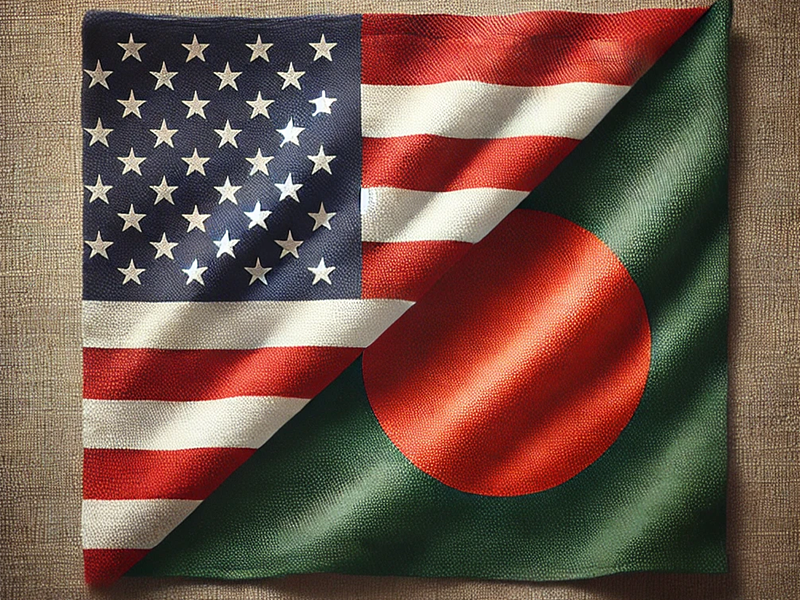
The United States and Bangladesh have begun formal discussions on a potential Free Trade Agreement (FTA), a move expected to strengthen bilateral trade and shift global supply chains toward more stable partners. The agreement, if finalized, would eliminate high tariffs on Bangladeshi exports — especially in the key garment sector — while anchoring the South Asian nation more firmly within the U.S. economic sphere.
Commerce Secretary Mahbubur Rahman confirmed that the U.S. has agreed in principle to begin drafting an FTA. An eight-member committee in Bangladesh has been tasked with preparing a draft within 15 days.
Bangladesh exports over 17 percent of its total goods and more than 18 percent of its garment products to the U.S., its largest single export market. Yet Bangladeshi garments face tariffs of more than 15 percent, compared to just 7 percent for competitors like Vietnam. A successful FTA would address this imbalance, giving Bangladesh a stronger position in the U.S. market and helping to maintain competitiveness.
RMG industry leaders view the proposed agreement as a major opportunity. Former BGMEA president Anwar-ul Alam Chowdhury Parvez said the deal would make Bangladesh more competitive globally. Commerce ministry data shows the U.S. is a critical destination for the country’s woven garments, knitwear and home textiles.
For the United States, an FTA would support efforts to diversify supply chains and reduce economic dependence on China. With its large, young workforce and rapidly growing manufacturing sector, Bangladesh is increasingly seen as a viable alternative. Some analysts believe the country could follow the development path of post-war Japan.
The economic ties are already significant. In the last fiscal year, Bangladesh exported $7.6 billion worth of goods to the U.S., while importing more than $2.55 billion in American products. Most of these imports, including cotton, soybeans, and scrap metal, are already subject to minimal or zero tariffs. This means an FTA would have limited impact on Bangladesh’s revenue collection.
Commerce officials are exploring temporary duty-free access for 100 U.S. products under the existing Trade and Investment Cooperation Framework Agreement. In return, they are seeking reduced tariffs on Bangladeshi exports until the FTA is finalized.
Progress on similar deals with other countries has stalled, making the U.S. FTA a priority. Experts caution that Bangladesh must improve labor rights, environmental standards and intellectual property protections to maximize benefits.
If completed, the agreement would boost trade, create jobs and reinforce strategic ties between the two nations at a critical moment in global economic realignment.