


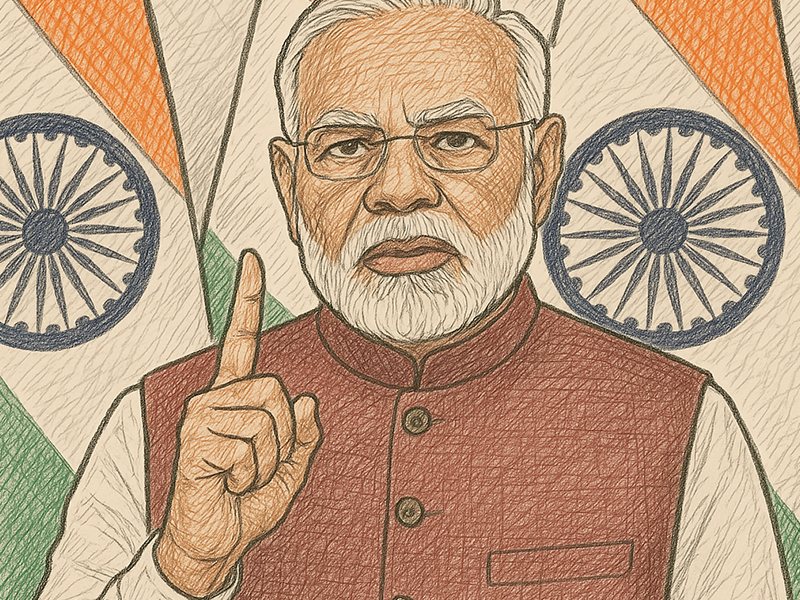
Indian Prime Minister Narendra Modi’s decision to launch Operation Sindoor in retaliation for a deadly terror attack in Kashmir was intended as a show of strength and deterrence. But a closer examination of the regional fallout and strategic responses suggests the operation may have backfired, ultimately strengthening Pakistan’s internal cohesion, reinforcing its military’s strategic calculus, and exposing the limits of India’s international leverage.
In the immediate aftermath of the conflict, Modi framed the offensive as a firm response to Pakistan-backed terrorism, signaling that India would no longer be constrained by the threat of nuclear retaliation. “India will not tolerate any nuclear blackmail,” Modi declared in a May 12 national address, according to reporting by Le Monde. He insisted that Operation Sindoor had inflicted heavy losses on Pakistani airbases and terror infrastructure, and that India had only “suspended” its retaliatory actions, not ended them.
But even as Modi projected resolve, the broader consequences of the operation revealed strategic missteps. The Pakistani response, far from fractured, was unified. Public celebrations broke out across Pakistan following the May 10 ceasefire, reinforcing national solidarity around the Kashmir cause. According to Foreign Policy, Kashmir remains central to Pakistan’s national identity and military doctrine, seen as the “jugular vein” of the country since its founding. This shared narrative was only reinforced by India’s military action.
Pakistan’s military, long accused of using terrorism as an extension of its foreign policy, viewed the latest crisis as confirmation that its asymmetric strategy remains effective. As Foreign Policy noted, nonstate actors continue to serve the dual purpose of keeping Kashmir unrest alive and challenging India’s control without inviting full-scale war. Despite Modi’s bold declarations, the groups targeted in Operation Sindoor are unlikely to be permanently degraded. Past patterns, including the 1999 Kargil conflict and the 2008 Mumbai attacks, demonstrate that Pakistan’s strategy of proxy conflict endures because it achieves political and strategic goals at relatively low cost.
Even within India, criticism mounted after the ceasefire. Analysts and media outlets such as Scroll.in questioned the lack of transparency regarding India’s military gains and raised concerns that Modi’s hardline posture had yielded little beyond rhetorical mileage. According to Le Monde, the prime minister was also reportedly frustrated by the role played by former U.S. President Donald Trump, who claimed to have brokered the ceasefire through economic threats to both sides. Modi rejected suggestions of U.S. mediation, framing the decision to deescalate as unilateral, a narrative aimed more at domestic consumption than geopolitical accuracy.
Most striking, however, was the apparent rallying effect Modi’s actions had within Pakistan. General Nirmal Chander Vij, India’s former Army chief, acknowledged in an NDTV interview that “Kashmir has been a weapon to unite the country” for Pakistan. Far from deepening Pakistan’s internal divisions, as some in Modi’s camp may have hoped, the operation offered Islamabad’s political and military leadership a moment of cohesion. Facing economic distress and political instability, Pakistan’s elite found common cause in resisting Indian aggression, reinforcing a narrative of external threat that has long underpinned the military’s dominance.
Meanwhile, India’s own strategic position faced limitations. As Le Monde highlighted, pressure from both the United States and China was instrumental in halting the escalation. While India remains a key partner for the U.S. in the Indo-Pacific, the episode revealed constraints in Washington’s support, particularly under a transactional approach that does not rule out dealings with Pakistan. China’s implicit backing of Pakistan through arms support further complicated India’s calculus.
Operation Sindoor may have momentarily bolstered Modi’s image as a decisive leader, but it also exposed the enduring challenge India faces: dealing with a nuclear-armed neighbor that continues to use Kashmir as both a unifying cause and a geopolitical lever. In attempting to change that reality through a limited military campaign, Modi may have achieved the opposite. The offensive revitalized Pakistan’s internal unity, reaffirmed its strategic doctrine, and revealed the geopolitical limits of unilateral action.