


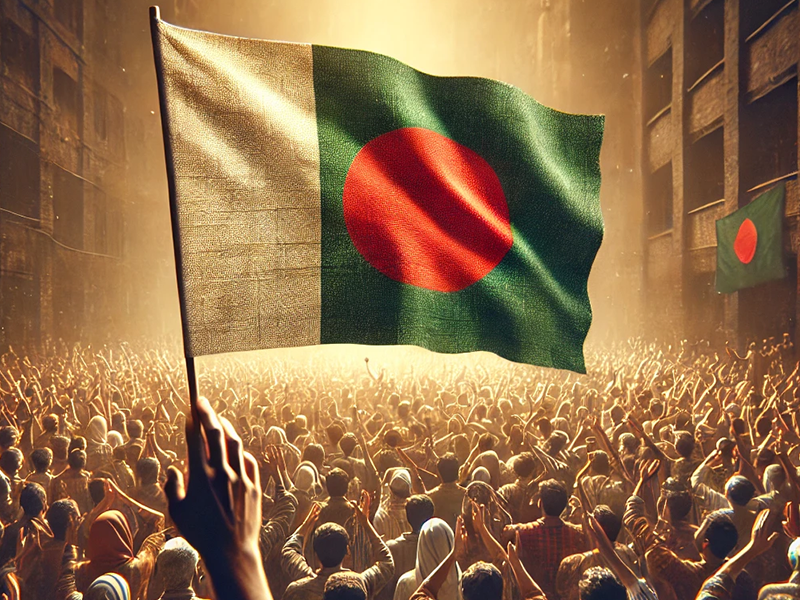
The interim government’s decision to ban the Awami League, one of Bangladesh’s most significant political parties, is a direct threat to democratic principles. Announced Saturday under the country’s Anti-Terrorism Act, the ban came in response to ongoing protests and public pressure, not a court verdict or completed trial. Yielding to street demands over legal procedure undermines the foundations of the rule of law and sets a dangerous precedent.
Founded in 1949, the Awami League played a leading role in Bangladesh’s independence and has governed for much of its modern history. Its most recent leader, Sheikh Hasina, was ousted and fled to India after violent unrest last year. Though her government faced strong criticism for authoritarian practices, banning her party outright before a legal resolution is reached violates the principle of due process. It punishes not just leaders accused of wrongdoing but also millions of citizens who supported the party at the ballot box.
The government, now led by Nobel Peace Prize laureate Muhammad Yunus, argues that the ban is necessary to maintain national security. It also amended the International Crimes Tribunal law to allow for the prosecution of political parties, not just individuals. This change, made under pressure from protesters, enables the state to treat the Awami League as a collective criminal entity before any formal ruling has been made. Legal systems should not be reshaped to fit the momentum of protest movements.
The roots of this crisis began with student protests over job quotas in mid-2024, which escalated into one of the deadliest political periods since the country’s founding. A United Nations fact-finding mission later confirmed that at least 1,400 people, including children, were killed by law enforcement and members of the ruling party. These are serious charges that must be addressed, but trials must precede punishment. Banning a party first and trying it later flips justice on its head.
Abraham Lincoln, in his 1838 Lyceum Address, warned of this exact danger when mob sentiment overtakes legal order. He described the tendency of societies to replace the “sober judgment of courts” with “the wild and furious passions” of crowds. In that speech, Lincoln argued that the greatest threat to a nation’s institutions would not come from foreign armies but from within, when citizens begin to destroy their own democratic structures out of fear or anger.
He cited the terrifying example of a man burned alive by a mob in St. Louis, reminding his audience that mob justice, once unleashed, cannot be easily controlled. “The mob of tomorrow may hang or burn someone who is neither a gambler nor a murderer,” he warned. That principle stands today in Dhaka, where the interim government has acted not as a protector of justice, but as a vessel for popular rage.
Bangladesh’s interim government was never elected to dismantle parties or redefine democracy. Its role is to stabilize the country and prepare for elections, not to pre-judge political organizations. In banning the Awami League, it risks disenfranchising millions and transforming what should be a temporary transition into a permanent rupture.
To uphold its legitimacy, the government must reverse the ban and ensure all trials are conducted fairly, without prejudice or pressure. Justice must be earned through evidence and law, not demanded from the street.
Lincoln concluded his address with a call for every citizen to defend the Constitution and the laws above all else. That kind of reverence is needed now in Bangladesh. Political stability and national healing will not come from silencing dissent but from proving that the country’s legal institutions are stronger than its anger.
Will Bangladesh choose the path of justice — or follow the dangerous pattern of history that Lincoln so clearly warned against?