


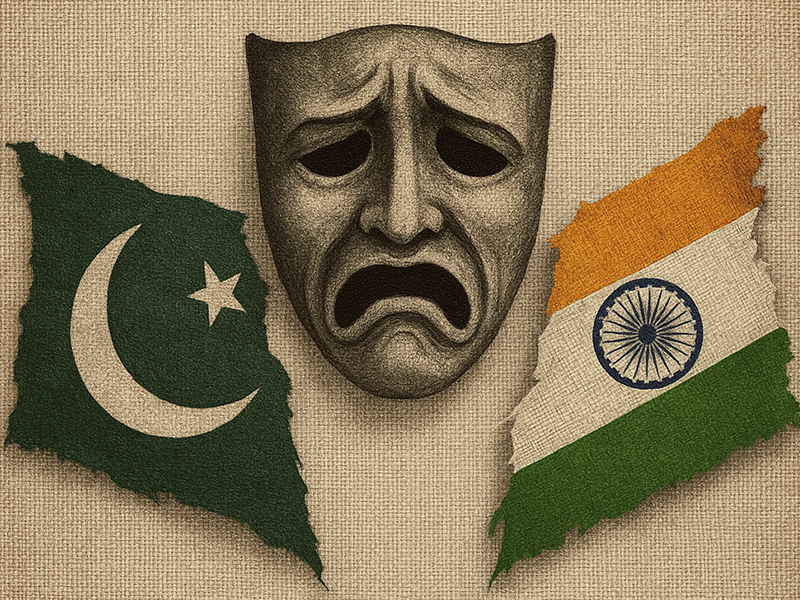
By any measure, war is a catastrophe. But for two nations where the average citizen earns less than $3,000 a year — India’s per capita income stands at $2,610, and Pakistan’s at $1,568 (World Bank, 2024 figures) — a full-scale military conflict is not just tragic, it is reckless self-harm. The 2025 India–Pakistan conflict, ignited by the horrific Pahalgam terrorist attack, is yet another chapter in a history of violence that has cost both countries dearly, not just in blood, but in lost opportunity.
Both India and Pakistan are fighting the wrong war. The real enemies are not across the border, but within their own borders: poverty, illiteracy, malnutrition, inadequate healthcare, and economic stagnation. The billions spent on jet fighters, missiles, and retaliatory strikes would be better used to fight the daily, grinding wars against these silent killers.
According to the United Nations, over 20 percent of Pakistan’s population lives below the poverty line, while India is home to over 228 million people living in multidimensional poverty, a number that swells when health, education, and living standards are factored in. Every Rafale jet shot down, every missile launched in Operation Sindoor, every life lost, is a grim ledger entry against hospitals unbuilt, schools unstaffed, and children unfed.
The current standoff, sparked by a heinous terrorist act, is a painful reminder that extremism thrives where hope dies. And hope dies in slums without schools, in hospitals without medicine, and in economies that exclude the many. Militancy is not just a security problem; it is a failure of justice, education, and inclusion.
The tragedy is compounded by misplaced priorities. Pakistan, with a GDP per capita barely above $1,500, is spending scarce resources maintaining a nuclear arsenal and a bloated military apparatus. India, the world’s most populous country, spends more on defense than on primary education. While fighter jets scream overhead, millions of children walk miles to under-resourced schools, if they go at all.
To break this cycle, both nations must declare a new kind of war: a war against shared suffering. Imagine if the energy and funds now fueling military escalation were redirected to regional cooperation on water, health, climate, and education. Imagine if the borders became bridges rather than flashpoints.
In the words of Leo Tolstoy, “The strongest of all warriors are these two — Time and Patience.” Peace is not won by missiles but by moral courage and visionary leadership. And as Shakespeare warned in Henry IV, “O, war! thou son of hell… belch forth thy blasphemies upon this world!” The battlefield solves nothing that compassion, dialogue, and justice cannot solve better.
India and Pakistan must abandon this ruinous repetition. Their real war is not with each other, but with the chains that bind their own people. The enemy wears no uniform. It wears hunger, ignorance, and despair.
It is time to fight that war instead.