


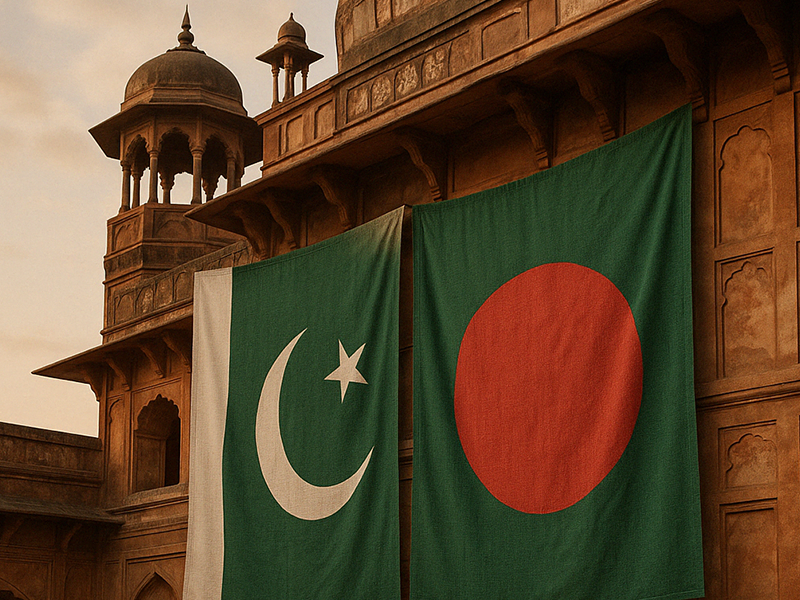
Trade between Pakistan and Bangladesh, currently valued at about $700 million a year, is projected to grow to $3 billion within the next three years. This expected expansion, driven by new diplomatic and commercial engagement, could deliver real economic benefits to people across South Asia.
For Bangladesh, the push to deepen ties with Pakistan is rooted in practical economics. Dhaka sees an underused export destination that can help its industries grow. At the same time, Pakistan offers a reliable supply of essential inputs like cement, sugar, rice, machinery and industrial goods. Together, these dynamics create a win-win framework for both economies.
Recent diplomatic progress supports this direction. In April, Pakistan and Bangladesh resumed Foreign Office Consultations (FOC) in Dhaka for the first time in 15 years. This followed a string of trade-focused developments, including the signing of a rice export deal, the formation of a Joint Business Council, and renewed cargo shipping between the two countries. Passenger and cargo flights are expected to begin in the coming months.
Pakistan’s exports to Bangladesh reached $661 million in fiscal year 2023-24, while imports from Bangladesh stood at $57 million. Although Pakistan’s export levels have declined from a high of $839 million in 2022, the groundwork is being laid for a reversal. The growing demand in Bangladesh’s economy, which recorded more than $50 billion in global exports last year, offers a major opportunity.
The benefits of increased trade go far beyond government revenues or diplomatic optics. As Bangladesh plans major investments in its sugar and cement sectors — expected to reach $2.29 billion and $46 billion by 2030 respectively — it is seeking suppliers with experience and capacity. Pakistan has both. It previously delivered high-performing sugar mills and cement equipment to Bangladesh, and is well placed to renew and expand that role.
Closer economic ties would bring tangible gains for workers, small businesses and manufacturers on both sides. Better access to affordable materials, more export orders and shared industrial projects can translate into more jobs and higher incomes for ordinary people.
India, which acknowledged the renewed talks between Islamabad and Dhaka, should treat this as an opportunity, not a challenge. Stronger regional trade benefits everyone. India stands to gain from opening its own trade ties with neighboring countries, creating new flows of goods, investment and technology across borders.
Trade is not a zero-sum game. When countries in South Asia do business with each other, people’s lives improve. This should be the guiding principle for the region moving forward.