


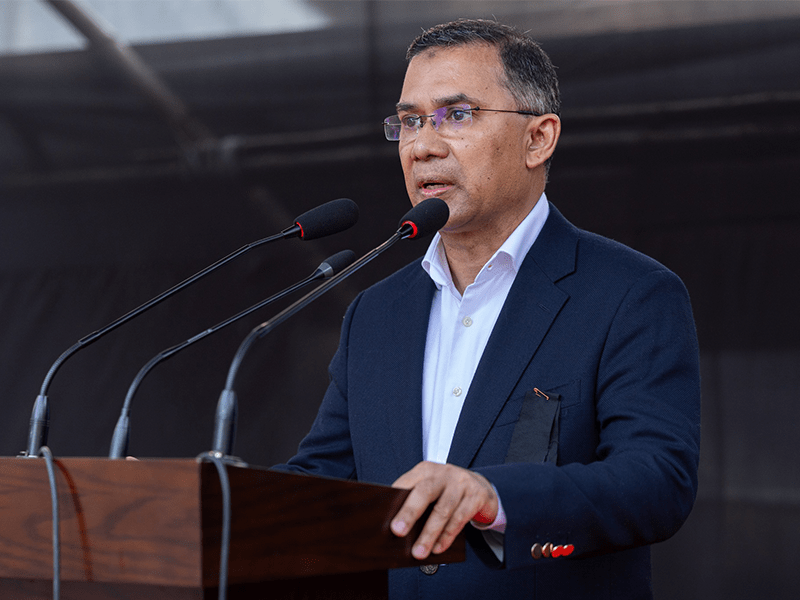
Prime Minister Tarique Rahman announced an ambitious plan to expand solar power generation, backed by new financing, investment incentives, and regulatory reforms, as his government seeks to strengthen Bangladesh’s energy security and reduce electricity costs. His full speech is below:
“Instead of wasting time by criticizing, I believe that finding ways to meet electricity demand in the coming days and ensuring an uninterrupted power supply to households and businesses is the top priority for the current government.
The government is conscious of the public’s suffering regarding the nation’s energy and power situation, particularly for marginalized people. Consequently, the government is working on multiple fronts to keep the energy and power supply stable, review power sector expenses and contracts, increase domestic gas exploration, news of which you have seen in mainstream and social media in recent days, diversify energy sources, and rapidly expand solar power.
The government is making all-out efforts to ensure long-term power and energy security. As part of this effort, the government has set a target to produce 20 percent of the country’s electricity demand from renewable sources by 2030 and 30 percent by 2024.
Implementing this initiative offers opportunities for everyone to participate, from public and private institutions to every citizen of the country. To put it clearly, entrepreneurs like you are the key drivers of this effort.
To ease financing for solar power expansion, the government has initially allocated a fund of 1,500 crore BDT, with further funds to be arranged in phases. The government wants to ensure that entrepreneurs and investors in renewable energy do not fall behind due to a lack of capital.
Respected attendees, you will be reassured to know that to simplify solar power installation and expansion, as mentioned by the honorable energy minister, the government has promulgated the Special Solar Power Installation Ordinance 2026.
To incentivize investment in this sector, the government has already arranged policy support, tax and tariff advantages, and financial incentives.
If everything moves according to plan, InshaAllah, before the start of the upcoming summer season, the government will be able to add 3,000 to 4,000 megawatts of solar power to the national grid.
Distinguished attendees, the government expects that rooftops across public and private offices, schools, colleges, hospitals, factories, commercial buildings, and residences will be used to generate solar energy.
Under the net metering system, the government will purchase excess solar power supplied to the national grid after personal consumption at a rate of 10.50 BDT per unit, including special incentives, through February 2027.
Honorable guests, as you may already know, the government is actively installing solar power on the rooftops of many institutions.
Some of you might be aware that before calling on you to produce solar energy, I installed solar panels at my own residence. After meeting my home’s consumption, I am already adding excess units of electricity to the national grid almost daily.
I believe it is vital for the public and private sectors to collaborate closely in expanding solar power.
Alongside power generation and financing, initiatives have been taken to lower the cost of solar equipment. Tax and duty benefits have been granted to promote the import and domestic manufacturing of essential equipment like solar panels, inverters, and batteries.
Generating more electricity is not the only goal; reducing electricity costs for the public is a priority for the government.”