


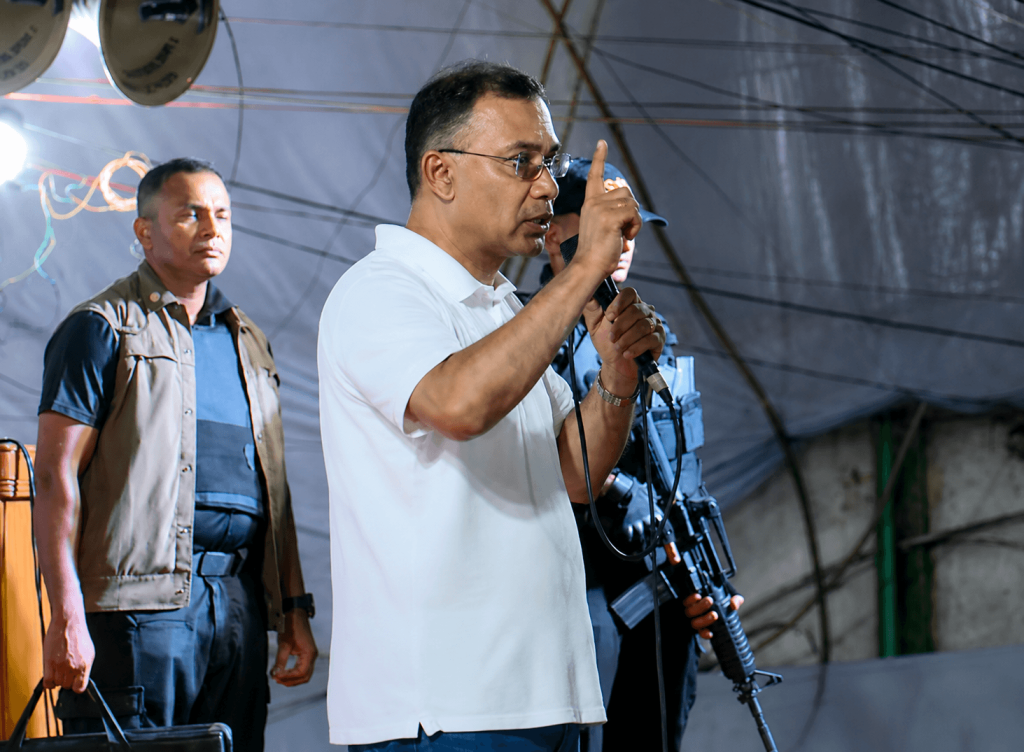
Prime Minister Tarique Rahman used his first visit to Cox’s Bazar since taking office to call for vigilance in protecting democracy, warning that instability could threaten the country’s political and economic progress.
“A vested quarter is trying to create unrest in the country by spreading confusion,” Rahman said, urging citizens to resist attempts to destabilize the nation. “Everyone must be vigilant so that no one can kill democracy in any way.”
The visit carried symbolic weight for Rahman, who last held a major grassroots conference in Cox’s Bazar in 2001. This time, he returned as prime minister, combining political messaging with development pledges across infrastructure, environment, social welfare and economic relief.
Rahman inaugurated the re-excavation work of the Patali Canal in Cox’s Bazar Sadar alongside the home and water resources minister. He also laid the foundation stones for the newly formed Pekua Municipality and Matamuhuri Upazila, presenting the projects as part of a broader push to strengthen local administration and public services.
“Our goal is to change the fate of the people of this country and that is why we have adopted plans and are working accordingly,” Rahman said.
The prime minister also highlighted the government’s move to remove taxes on 60 daily essential products, including rice, dal, oil and salt. Officials said it marked a rare moment in Bangladesh in which prices of daily essentials did not rise after the budget announcement.
Rahman framed the measure as part of a wider effort to protect ordinary citizens from economic pressure.
“Today we must be careful so that no one can snatch away the economic freedom of the people of Bangladesh, which is gradually getting stronger,” he said.
Accompanied by his wife, Dr. Zubaida Rahman, the prime minister visited Dulahazra Safari Park, where he planted a Nagalingam sapling. At Malumghat, he formally inaugurated the Bangladesh Nationalist Party government’s election pledge to plant 250 million trees over five years.
Rahman also visited the grave of Wasim, the first martyr of the July uprising from Cox’s Bazar district, in a gesture that linked his message of democratic vigilance to the sacrifices made during the movement.
The government is also rolling out its pre-election welfare commitments, including the Family Card and Farmer Card programs, which Rahman said are intended to support people across all classes.
“The 20 crore people of Bangladesh are the owners of the country,” Rahman said, casting public ownership, democratic protection and national stability as central themes of his government’s agenda.