


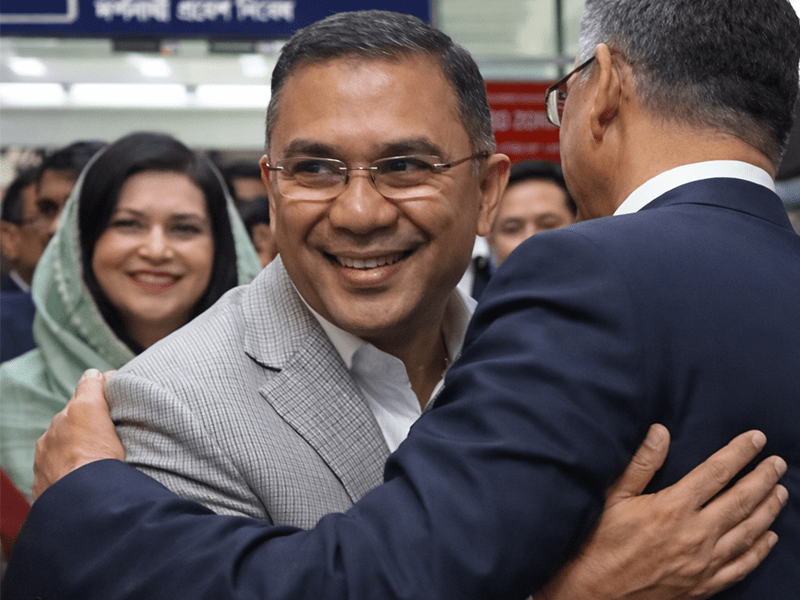
Bangladesh Nationalist Party (BNP) acting chairman Tarique Rahman used his return address to blend faith, history, and politics, presenting his comeback as a moment of divine mercy and popular will while outlining a vision centered on democracy, unity, justice, and restraint amid warnings of conspiracies and unrest. Below are the central themes Rahman emphasized in his speech:
Return to the country framed as divine mercy and popular support
Rahman opened by crediting God and public prayers for his return, anchoring his presence in religious faith and popular legitimacy.
“By His infinite mercy and your prayers, I have been able to return to my beloved motherland among you.”
Historical continuity of struggle for sovereignty and democracy
He situated current events within a long arc of national resistance, citing 1971, 1975, 1990, and 2024 as moments when people defended sovereignty and democracy.
“This beloved motherland of ours was earned in 1971 through the blood of millions of martyrs… in 1990, the people of this country snatched back their democratic rights against autocracy… in 2024… people from all walks of life… protected the independence and sovereignty of this country on August 5th.”
Demand for restoration of democratic and civic rights
Rahman said the public now seeks freedom of expression, democracy, and fair treatment based on merit.
“Today, the people of Bangladesh want their right to speak back; they want their democratic rights back. They want to receive their fair rights according to their qualifications.”
Vision of an inclusive and safe Bangladesh
He emphasized national unity across geography and religion and framed safety as a core aspiration.
“This country belongs to the people of the hills and the plains alike; it is home to Muslims, Buddhists, Christians, and Hindus… a safe Bangladesh where any person, man, woman, or child, can leave home and return safely.”
Focus on youth and marginalized groups
Rahman highlighted the scale of youth, children, people with disabilities, farmers, and laborers, arguing their aspirations must shape the state.
“Our population includes more than 40 million members of the youth generation… around 4 million people with disabilities, and millions of farmers and laborers. These people have expectations and aspirations for this state.”
Condemnation of repression and remembrance of martyrs
He accused past authorities of enforced disappearances and killings, linking past and recent sacrifices to a moral obligation to rebuild the country.
“For the past 15 years, hundreds and thousands have been victims of enforced disappearances and murders under the autocracy… To repay the ‘blood debt’ of martyrs like Osman Hadi and those from 1971, let us build the Bangladesh we all expect.”
Warning about conspiracies and call for restraint
Rahman cautioned against provocation, urging patience and a firm commitment to peace and order.
“Agents of various hegemonic powers are currently engaged in various conspiracies. We must be patient… We must maintain peace and order at any cost and stay calm in the face of any provocation.”
Transition from rhetoric to a concrete political plan
He contrasted Martin Luther King’s dream with his own emphasis on planning and democratic cooperation.
“Today… I want to say as a member of the Bangladesh Nationalist Party (BNP): ‘I have a plan’. This plan is for the interest of the people, the development of the country, and changing the fate of the citizens.”
Commitment to justice-based governance
Rahman framed future governance as guided by Islamic principles of justice.
“Let us all promise that those who take responsibility for governing the country in the future will try their best to rule in the light of the justice of Prophet Muhammad (PBUH).”
Personal appeal regarding Khaleda Zia and closing call for unity
He asked for prayers for his mother while reiterating a final appeal for peace and collective action.
“As her son, I ask for your prayers for her recovery… We must ensure that peace and order are maintained at any cost, regardless of religion, class, or political affiliation.”