


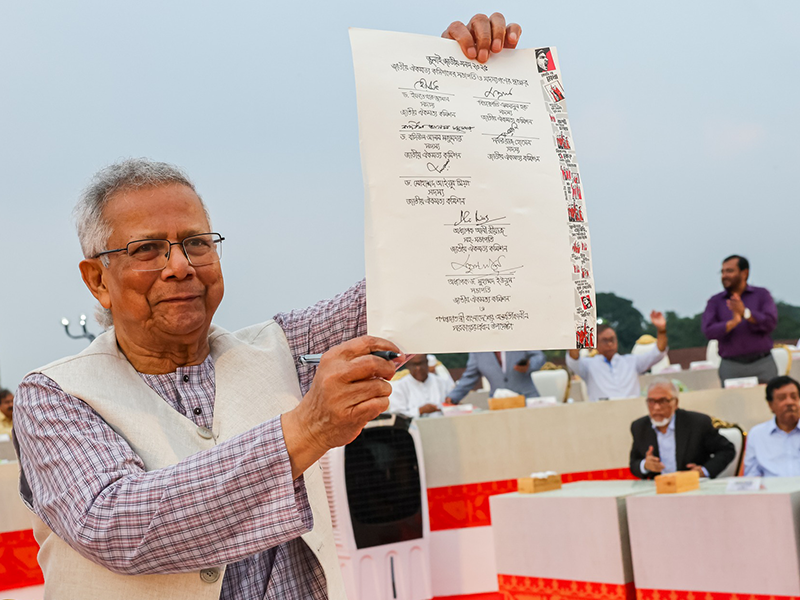
The July Charter is a landmark political document signed in Bangladesh on Oct. 17, 2025, that outlines a sweeping roadmap for state reform. It aims to fundamentally restructure the government following the ouster of longtime Prime Minister Sheikh Hasina in 2024.
The charter, named after the student-led “July Revolution” that led to the government’s collapse, contains 84 distinct reform proposals. It was drafted by a National Consensus Commission, an independent body established by the interim government and led by Chief Adviser Muhammad Yunus.
Here’s an explainer on what the charter is, what it proposes, and its significance.
Why Was the Charter Created?
The charter is a direct response to the July 2024 mass uprising. Protesters, led by students, demanded an end to what they called an increasingly autocratic system under former Prime Minister Sheikh Hasina, who had been in power for 15 years.
The movement, which began over a job quota system, quickly evolved into a nationwide protest against perceived government corruption, human rights abuses, and the concentration of power in the hands of the prime minister.
After Hasina fled the country in August 2024, an interim government led by Nobel laureate Muhammad Yunus was formed. Its primary mandate was to draft a new social and political contract to prevent a return to authoritarianism and prepare the country for free and fair elections. The July Charter is the result of that mandate.
What Are the Key Proposals?
The charter’s 84 points are designed to systematically dismantle the centralized power structure of the previous government. The main themes are:
- De-concentration of Power: The central goal is to create checks and balances. This includes limiting a prime minister to a total of two terms and expanding the president’s powers to include appointing heads of key independent commissions, an authority previously held by the prime minister.
- Judicial Independence: A major section focuses on separating the judiciary from executive influence. Key proposals include creating a Supreme Court Secretariat to control judicial promotions and transfers (instead of the Ministry of Law) and reforming the appointment process for High Court and Supreme Court judges.
- Institutional Reform: The charter proposes granting constitutional status to key oversight bodies, including the Anti-Corruption Commission (ACC) and the Election Commission. It seeks to make their appointments non-partisan by requiring multi-party committees, rather than the prime minister alone, to select their leadership.
- Accountability and Transparency: It introduces new anti-corruption measures, such as requiring all elected officials to publicly declare their assets annually, amending secrecy laws to increase access to information, and empowering the ACC to investigate officials without prior government approval.
- Legislative Changes: The charter proposes the creation of a bicameral legislature, adding an upper house to the existing unicameral parliament. It also mandates that the deputy speaker and chairs of key parliamentary committees be selected from the opposition party.
Who Signed It and Who Didn’t?
The charter was signed at a large ceremony in Dhaka by the National Consensus Commission and 25 political parties. Notable signatories include the Bangladesh Nationalist Party (BNP) and Jamaat-e-Islami, two major political forces that were in opposition to the Hasina government.
However, the signing was marked by significant boycotts. The National Citizen Party (NCP), the student-led political group that spearheaded the 2024 uprising, refused to sign. The NCP and several leftist parties argued the charter lacked a clear, legally-binding roadmap for its implementation.
What’s Next?
The July Charter is a political consensus, not a legally binding document. Its proposals must be formally adopted to become law.
The charter itself outlines a point of contention: how to implement it. Some parties want the reforms passed by the next elected parliament, while others have called for a national referendum to be held before the upcoming elections, which the interim government has slated for February 2026.
While Chief Adviser Yunus hailed the signing as the “birth of a new Bangladesh,” the boycotts and public protests highlight the deep challenges that remain in unifying the country around a single path for its political future.