


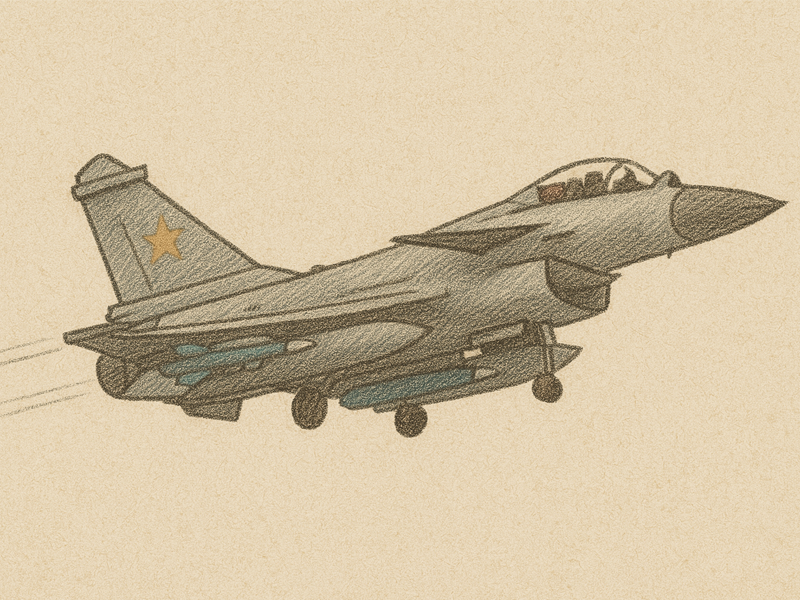
The Chengdu J-10, known by its NATO reporting name “Firebird,” is a single-engine multirole fighter that has become a mainstay of the People’s Liberation Army Air Force (PLAAF). Designed by the Chengdu Aircraft Corporation, the J-10 represents one of China’s first fully indigenous fourth-generation combat aircraft, combining advanced aerodynamics with modern avionics and weapons systems.
The J-10 features a tailless delta wing and forward-mounted canards that give it exceptional maneuverability and stability in high-performance flight. Its digital fly-by-wire control system allows precise handling, while a bubble canopy provides the pilot with full 360-degree visibility. Powered by a Russian-built Saturn Lyulka AL-31F turbofan engine, the jet can reach speeds of up to Mach 2 and operate at altitudes approaching 60,000 feet.
Armed with a 23 mm Gryazev-Shipunov GSh-23 cannon and up to 11 external hardpoints, the J-10 can carry air-to-air and air-to-ground weapons, including PL-10 and PL-12 missiles. The aircraft’s combat radius extends more than 2,500 kilometers when equipped with drop tanks.
Since entering service in the mid-2000s, the J-10 has undergone continuous upgrades. The latest variant, the J-10C, features an active electronically scanned array (AESA) radar, advanced electronic warfare pods, and compatibility with the long-range PL-15 missile.
Analysts say the Firebird’s evolution highlights China’s progress in domestic aerospace manufacturing and its shift toward technological self-reliance, positioning the aircraft as a rival to Western fighters like the F-16 and Gripen.