


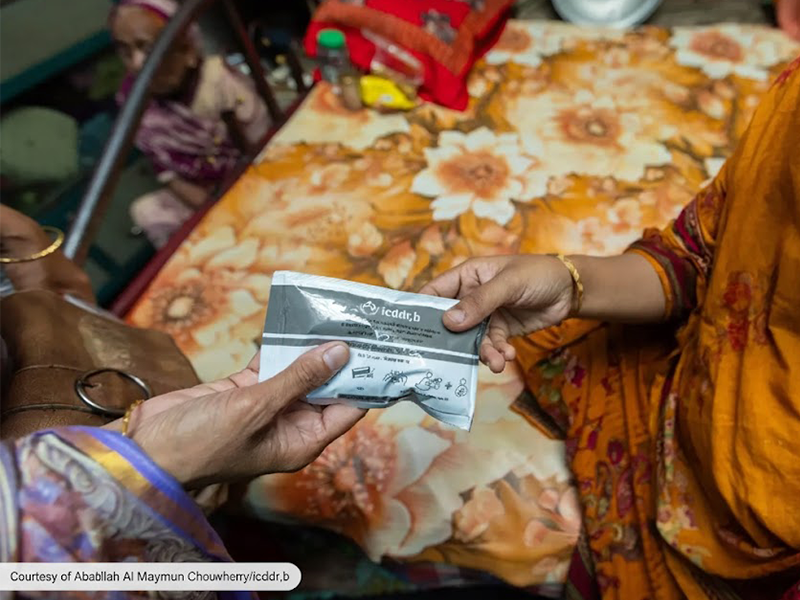
A complementary food for undernourished children developed by Bangladesh’s International Centre for Diarrhoeal Disease Research (icddr,b) and Washington University in St. Louis has been named one of TIME magazine’s Best Inventions of 2025 under the Social Impact category.
The innovation, called MDCF-2 or microbiome-directed complementary food, contains a mix of chickpea flour, soybean flour, peanut flour, and green banana. The ingredients were chosen for their ability to nourish beneficial gut bacteria that promote healthy growth, immune function, and brain development in malnourished children.
Developed through a long-term collaboration between Dr. Tahmeed Ahmed, executive director of icddr,b, and Dr. Jeffrey Gordon, director of the Edison Family Center for Genome Sciences and Systems Biology at Washington University, the food has shown strong results in Bangladesh. Clinical trials found that MDCF-2 helps repair the gut microbiome and improve growth outcomes.
“Conventional foods bring only temporary recovery. Once you stop the food, malnutrition returns. That’s why we studied the gut microbiome — to design food that heals from within,” said Ahmed. “This is a food not only for the child, but for the gut microbiota — the good bacteria that drive healthy growth, brain development, and immunity.”
Major studies are now under way in India, Pakistan, Mali, and Tanzania. Icddr,b said the recognition underscores how locally developed, affordable science can help millions of children “not only survive but thrive.”