


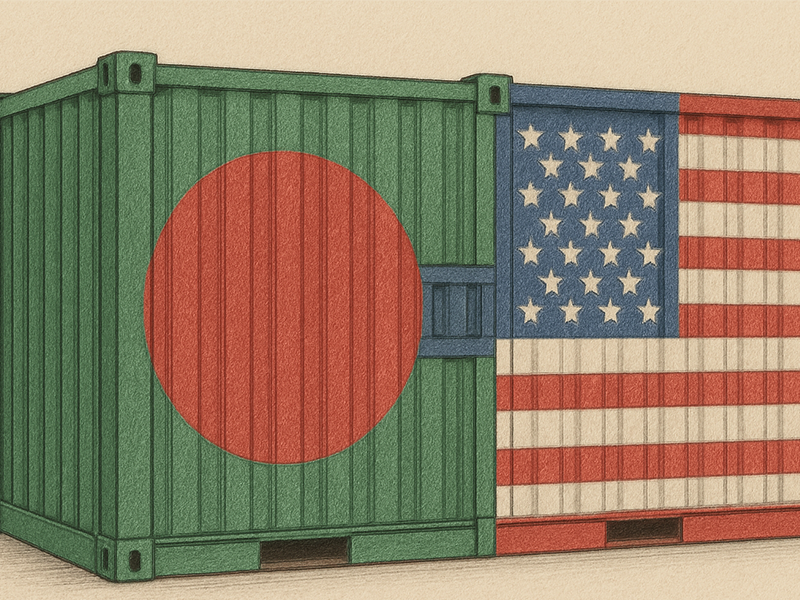
The Bay of Bengal, once considered a geopolitical backwater, has reemerged as one of the world’s most contested maritime zones. For Bangladesh, perched on its northern shores, the region is both an opportunity and a looming risk. The United States, seeking to counterbalance China’s growing footprint in the Indo-Pacific, is eyeing Bangladesh as a critical partner. A recent Economic Times report revealed that Washington has initiated discussions in Dhaka about developing a port under the Quad Ports for Future program, a move that could cement American presence in the Bay of Bengal. For a country that has historically sought balance between competing powers, this overture from Washington highlights the stark reality: Bangladesh is at the epicenter of a brewing great-power rivalry.
The Bay of Bengal as a Geopolitical Battleground
The Bay of Bengal is no ordinary body of water. It is the world’s largest bay, home to a quarter of the global population in its littoral states, and a corridor through which nearly a quarter of all traded goods flow. More than half the world’s container traffic and a third of global trade pass through this maritime highway, including vast shipments of oil and liquefied natural gas destined for energy-hungry economies in East Asia. It is no exaggeration to call the Bay an “economic highway of the world.”
But the region’s significance extends beyond economics. It sits at the junction of South and Southeast Asia, a connector between the Indian and Pacific Oceans, and a fulcrum of the broader Indo-Pacific strategy. The Bay is where the strategic interests of China and India overlap and collide. For Beijing, the Bay is an answer to its “Malacca Dilemma”—the fear that its energy imports could be cut off at the narrow Strait of Malacca. Through its Belt and Road Initiative, China has invested in ports and pipelines in Myanmar and Sri Lanka, building alternate routes to the Indian Ocean. For India, long the dominant power in South Asia, the Bay is its natural sphere of influence and the lifeline for its growing economy. The United States and its allies, meanwhile, view the Bay as critical to ensuring that no single power dominates the Indo-Pacific.
Against this backdrop, the U.S. push for a port in Bangladesh signals more than just commercial interest. It is about embedding America in the very heart of the Indo-Pacific contest, securing a foothold in a space where China has been steadily gaining ground and where India is wary of encirclement.
Bangladesh: Rising, but Vulnerable
For Bangladesh, this attention is both flattering and fraught. Once dismissed as a “basket case,” the country has become one of Asia’s fastest-growing economies, driven by low-cost manufacturing, remittances, and infrastructure development. The Bay itself offers enormous untapped potential: estimates suggest Bangladesh may hold up to 200 trillion cubic feet of natural gas reserves, while its coastline is integral to regional trade and energy routes.
Yet the risks are real. Bangladesh is acutely vulnerable to climate change; by 2050, rising seas could submerge 11 percent of its landmass, displacing millions. Politically, Dhaka must navigate fraught relations with neighbors, from the Rohingya refugee crisis with Myanmar to its reliance on India for transit and energy cooperation. Any misstep in aligning too closely with one power could provoke blowback from others.
The Realist Lens: What Bangladesh Ought to Do
If we view the Bay of Bengal through a realist lens, the logic is unforgiving. Great powers, whether China, India, or the United States, act primarily to maximize their influence and secure their strategic interests. Small states like Bangladesh are not free agents; they exist in the shadow of stronger neighbors and must play their cards with care.
What, then, should Bangladesh do?
First, Dhaka must recognize that it cannot afford to be dominated by any single power. China’s deep economic involvement, India’s geographic dominance, and the U.S. security agenda all come with strings attached. To survive, Bangladesh must adopt a strategy of “hedging”—accepting investments and cooperation from all sides while carefully avoiding permanent alignment with any.
Second, Bangladesh should leverage its geography. Its ports—Chittagong, Mongla, and the upcoming Matarbari deep-sea port—are gateways not just for itself but for landlocked Northeast India, western China’s Yunnan Province, and even Himalayan neighbors. By positioning itself as an indispensable transit hub, Bangladesh can extract concessions and investments from multiple players.
Third, Dhaka must focus on building resilience at home. Strong economic growth, diversified energy supplies, and a professionalized military capable of defending sovereignty are the best deterrents against external coercion. Weak states invite intervention; stronger ones can resist it.
Finally, Bangladesh must avoid being drawn into the security architectures of great powers, particularly U.S.-led military arrangements. Joining explicitly anti-China groupings may appear attractive in the short term, but it risks retaliation and dependency. A realist strategy calls for maintaining strategic ambiguity: cooperating with Washington on trade and infrastructure while quietly accommodating China’s economic role and managing India’s unavoidable influence.
The Bay of Bengal is rapidly emerging as a key battleground in the great-power struggle for dominance in the Indo-Pacific. Bangladesh, located at the very heart of this contest, has little room for error. The United States’ interest in a port underscores just how central Dhaka has become in global calculations. But as John Mearsheimer would argue, the only path for Bangladesh’s survival and prosperity lies in a cold-eyed realism: play all sides, avoid entrapment, and focus relentlessly on building national strength. In the unforgiving logic of geopolitics, Bangladesh cannot change the game, but it can—and must—master the art of survival within it.