


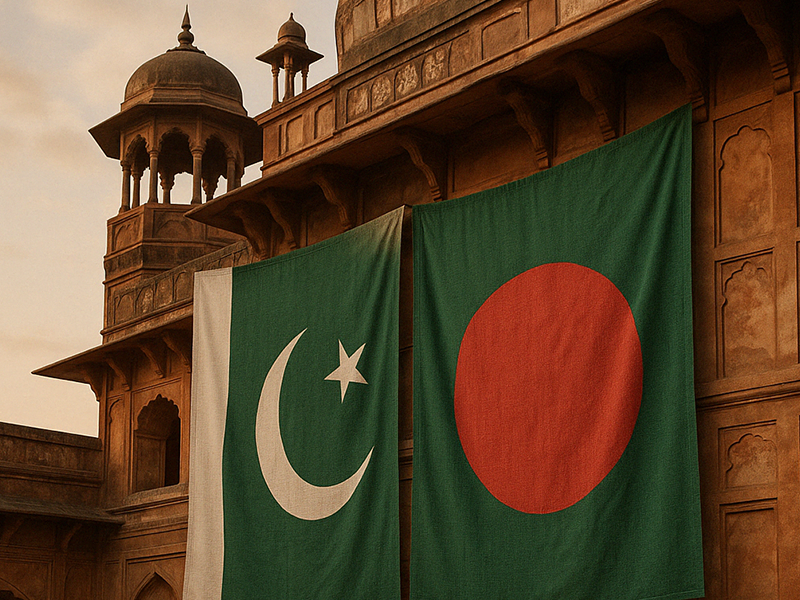
Pakistan’s deputy prime minister and foreign minister arrived in Dhaka on Saturday in a visit that marks the highest-level contact between the two countries since 2012, signaling a potential thaw in historically tense relations.
Senator Muhammad Ishaq Dar is in Bangladesh for a two-day visit at the invitation of the Bangladeshi government. He was received at Hazrat Shahjalal International Airport by Bangladesh’s foreign secretary, Ambassador Asad Alam Siam, along with Pakistan’s High Commissioner to Bangladesh, Imran Haider, and other senior officials.
During his stay, Dar is scheduled to meet with top Bangladeshi advisers, including Chief Adviser Professor Muhammad Yunus, Foreign Affairs Adviser Md. Touhid Hossain, and Commerce Adviser SK Bashir Uddin. The meetings aim to enhance bilateral cooperation and discuss broader regional and international issues of mutual concern.
Hossain told Prothom Alo, “Like with many other countries, we are trying to establish a normal relationship with Pakistan, focusing on trade, investment, and facilitating people’s movement. In the past, an unnecessary atmosphere of hostility was created. We have moved away from that. But while seeking normal ties, the three unresolved issues remain on the table.”
The visit comes amid renewed economic interest between the two South Asian nations. According to data from the Export Promotion Bureau and Bangladesh Bank, bilateral trade stood at $689.76 million in the 2023–24 fiscal year, down from $782.63 million the year before. Bangladesh exported goods worth just $61.98 million to Pakistan in FY24, while imports reached $627.78 million, reflecting a significant trade imbalance.
Despite the current trade gap, analysts note that the visit could pave the way for deeper engagement. Bangladesh is seeking to expand its export footprint into Pakistan’s markets, particularly in garments, jute products, and pharmaceuticals. Pakistan, meanwhile, remains a supplier of machinery, agricultural goods, and chemical products.
“This is overlooked, but very significant,” said Leela Jacinto, an international affairs reporter at France 24. “These two countries have very painful histories.”
The 1971 war that led to Bangladesh’s independence from Pakistan continues to cast a long shadow over diplomatic relations. However, since the political transition in Dhaka last year, both countries appear to be exploring new avenues of engagement, especially in trade and regional cooperation.
India, historically Bangladesh’s closest ally and a key player in the country’s 1971 liberation, is closely monitoring the developments. “This is being watched very closely by India. India is very concerned,” Jacinto said.
Observers say India’s influence in Dhaka has weakened, particularly as Prime Minister Sheikh Hasina continues to reside in India following her departure from Bangladesh during the regime change in 2024. Her presence in India has fueled political tensions and drawn criticism from opposition groups in Bangladesh, who accuse her of seeking safe haven to avoid legal proceedings back home.
Meanwhile, shifts in international alignments are also impacting regional dynamics. U.S. President Donald Trump, once an ally of India’s Prime Minister Narendra Modi, has distanced himself from New Delhi over what aides have described as Modi’s hubris. At the same time, India’s growing engagement with China has raised questions in Washington and among its South Asian neighbors.
As Pakistan and Bangladesh test the waters of renewed bilateral engagement, India faces a more complicated strategic environment in its immediate neighborhood. Analysts suggest that if New Delhi hopes to maintain influence in Dhaka, it may need to reevaluate its current posture and reengage with emerging political leadership in Bangladesh.
Despite lingering political sensitivities, the momentum from Dar’s visit may open the door to long-term cooperation if both countries can move past historical grievances and focus on economic opportunities that remain largely untapped.