


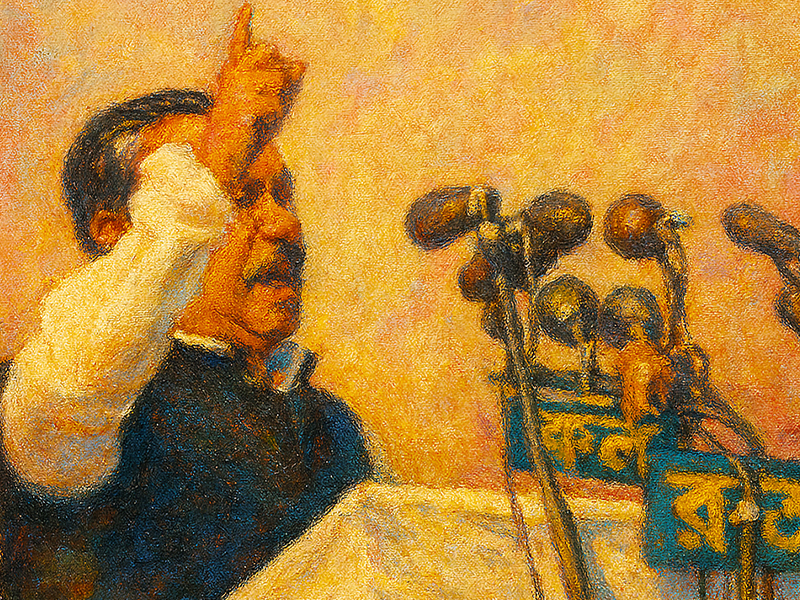
Mujibism is the ideological framework laid out by Sheikh Mujibur Rahman in the aftermath of Bangladesh’s 1971 independence and enshrined in the nation’s 1972 constitution. Built on four foundational principles — nationalism, socialism, democracy and secularism — Mujibism has guided successive governments’ policies and remains a central reference point in Bangladesh’s political discourse.
Sheikh Mujibur Rahman, the principal architect of Bangladesh’s liberation, articulated Mujibism as a blueprint for rebuilding a war-torn country. The 1972 constitution codified its four pillars, reflecting his vision of a sovereign nation defined by a common Bengali identity, an economy attentive to social justice, popular participation in governance and the separation of religion from state affairs.
Nationalism under Mujibism emphasizes a shared cultural and linguistic heritage among Bengali-speakers. Rahman sought to transcend regional, ethnic and religious divides by promoting Bengali language instruction, celebrating Liberation War anniversaries and fostering a sense of collective pride. Critics, however, caution that an overemphasis on a singular cultural narrative risks marginalizing indigenous groups and non-Bengali communities.
Socialism in its original form called for state-led economic planning, nationalization of key industries and redistributive welfare measures. In practice, early government undertakings included land reform and national control of banks, jute mills and transport. While those interventions aimed to reduce inequality, chronic inefficiencies and fiscal strain led later administrations to integrate market mechanisms alongside social safety nets.
Democracy, the third pillar, was envisioned as a parliamentary system ensuring accountability and broad political representation. Mujibism endorses regular competitive elections and protections for civil liberties. The first years after independence saw multiparty contests, though a shift to a one-party state in 1975 departed from this ideal. Since restoration of plural politics in 1979, democracy remains a contested terrain, with debates over electoral fairness, the role of caretaker governments and the strength of opposition voices.
Secularism under Mujibism mandates that government institutions remain neutral in matters of faith. Rahman’s early government abolished religious titles for the state and banned communal organizations. In subsequent decades, constitutional amendments reinstated Islam as state religion before secularism was reaffirmed in 2011. Today, secularism continues to face pressure from both Islamist movements and those who argue religion should play a greater societal role.
Beyond its four pillars, Mujibism encompasses a self-reliance ethos. Rahman urged development of indigenous industry and rural uplift through cooperatives and agrarian projects. This spirit has inspired infrastructure drives such as bridges, power plants and road networks, though critics point to environmental impacts and governance lapses in project execution.
Mujibism also endorses scientific thinking and environmental stewardship. Early plans for land reclamation and irrigation sought to harness technology for food security, yet rapid industrialization and urban growth have strained ecosystems, sparking calls for stronger ecological safeguards.
On foreign policy, Mujibism championed nonalignment, with Bangladesh joining the Non-Aligned Movement and maintaining balanced ties amid Cold War rivalries. Maritime boundary settlements and regional partnerships reflect its continuing influence, even as some policymakers lobby for deeper engagement with major neighbors.
Nearly half a century after its inception, Mujibism remains a touchstone for debate in Bangladesh. Proponents view it as a unifying doctrine that underpins social progress and sovereign dignity. Critics argue that its broad tenets have sometimes been used to justify authoritarian practices or to consolidate power. As Bangladesh evolves, interpretations of Mujibism will continue to shape the nation’s political trajectory and social fabric.