


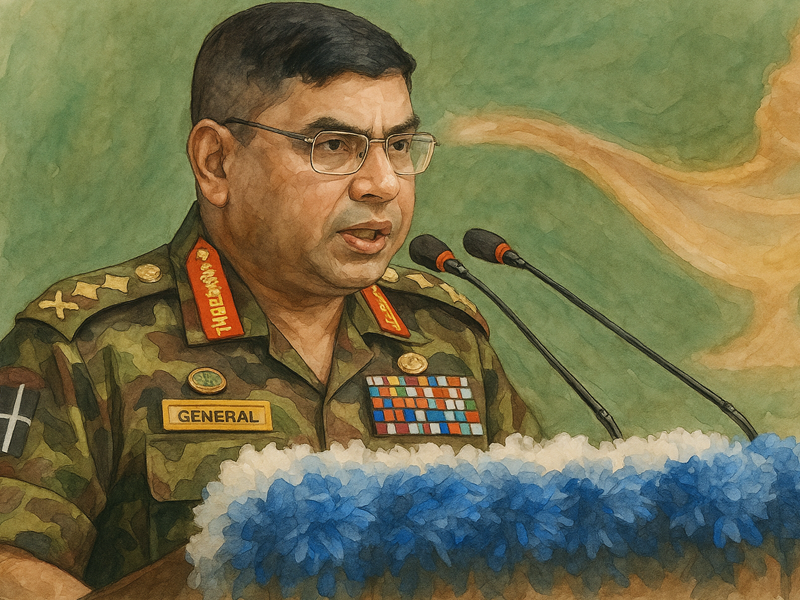
During a high-level gathering held at Dhaka cantonment, Chief of Army Staff Gen. Waker-Uz-Zaman delivered a comprehensive address covering the timing of national elections, the constitutional role of the military, national sovereignty, and several matters of public concern. The following summarizes the main points, as reported by sources who spoke to The Daily Star.
- National Election Timing
Gen. Waker stated unequivocally that the next national election should be held by December 2025. He emphasized that Bangladesh’s political stability hinges on the presence of a legitimate, elected government. In his words, only a government with a public mandate can govern with the necessary credibility. He further reiterated that the military’s role in civil matters must be temporary. “We must return to barracks after elections,” he said, warning that prolonged involvement in non-military affairs could weaken the institution’s core defensive capacity. - Military Role and Constitutional Boundaries
In his address, the army chief reaffirmed that the Bangladesh Army is fundamentally tasked with national defense, not domestic law enforcement. He cautioned against long-term military deployment in civil operations, arguing that such a role shift risks diminishing the preparedness and effectiveness of the armed forces. He called on both officers and policymakers to respect the constitutional boundaries that define the military’s responsibilities. - Humanitarian Corridor to Rakhine State
Gen. Waker directly addressed growing speculation about a potential humanitarian corridor into Myanmar’s Rakhine state. He firmly opposed the idea, calling it “risky and sensitive,” and warned that it could entangle Bangladesh in a broader regional conflict. He stressed that the sovereignty of the country is non-negotiable and that no such decision should be made by an unelected administration. In his words, “There will be no corridor. The sovereignty of Bangladesh is not negotiable.” - Decisions Involving Strategic Assets
The army chief expressed concern over critical national security decisions being taken without an elected government in place. He specifically cited the Chattogram seaport and the potential launch of Starlink satellite services as examples of decisions that demand public accountability and democratic oversight. He warned that the military will not permit any steps that compromise Bangladesh’s strategic autonomy or national interest. - Rise in Mob Violence and Internal Disorder
Responding to questions from officers, Gen. Waker addressed the rise in mob violence and public disorder. He stated that the army will not tolerate unrest that endangers civilians or undermines national stability. He also pledged to defend the country’s historical legacy and national pride against any attempts to distort or malign it, either from within or outside the country. - Targeted Attacks on National Institutions
Gen. Waker warned that vested groups are actively working to destabilize the country by undermining core institutions. He noted that the Rapid Action Battalion (RAB), the Directorate General of Forces Intelligence (DGFI), the National Security Intelligence (NSI), and the National Telecommunication Monitoring Center (NTMC) have all been targeted in coordinated campaigns. According to him, the objective of these efforts is to weaken national security and manipulate Bangladesh’s political future for narrow personal or political gain. - Economic Concerns
The army chief also raised alarm over recent economic developments, particularly the closure of multiple garment factories. He expressed concern that the nation’s response to these developments has been marked by silence, which he described as both troubling and dangerous. He implied that the lack of urgency around these economic indicators poses a serious long-term risk. - Online Smear Campaigns and Internal Discipline
Officers present at the event brought up the issue of false and defamatory campaigns targeting the army and its leadership. In response, Gen. Waker ordered appropriate action against the spread of misinformation and emphasized the importance of preserving internal discipline. He addressed calls to publicly expose dismissed personnel involved in misconduct, saying that while the military’s values discourage public shaming, that position could change if certain limits are crossed. - Closing Remarks
In closing, Gen. Waker reminded all military personnel that the army stands firmly with the people of Bangladesh and does not engage in political gamesmanship. “We are not part of any political game. We stand for Bangladesh,” he said. He urged the armed forces to remain united, uphold discipline, and continue to protect the rights of the country’s most vulnerable citizens.
Although Gen. Waker did not directly mention foreign press coverage, it is evident that segments of the Indian media have gone into overdrive in recent weeks, airing stories that emphasize internal divisions and forecast political instability in Bangladesh. Many of these reports appear speculative, often built on anonymous sourcing or unverified claims, and tend to echo long-standing narratives aimed at questioning the strength and unity of Bangladesh’s institutions. This trend suggests a coordinated effort to shape regional perception during a politically sensitive period. The timing and intensity of the coverage raise concerns that external actors may be seeking to influence domestic discourse and public sentiment by amplifying stories of discord.