


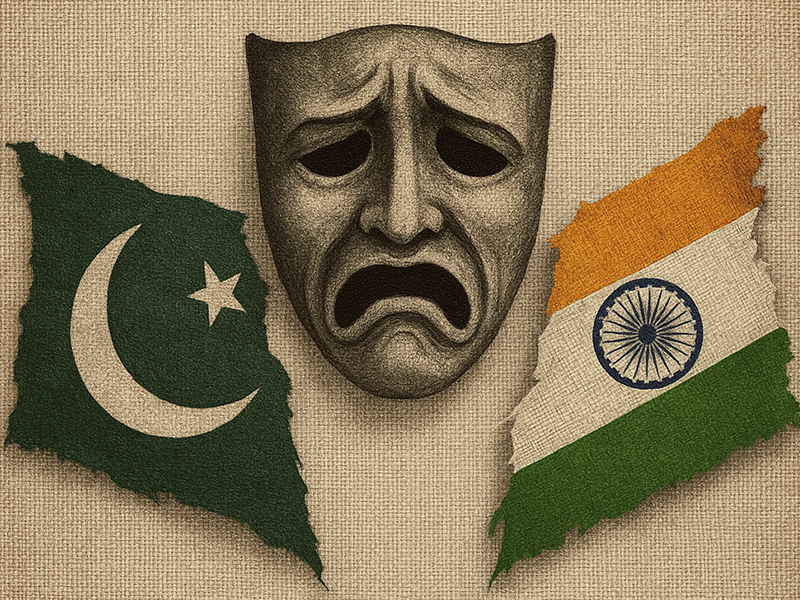
India and Pakistan are once again accusing each other of religious extremism. But behind the rhetoric lies a deeper irony: both nations, shaped by religious nationalism, are increasingly mirroring each other in ideology and intent.
India’s External Affairs Minister S. Jaishankar recently criticized Pakistan’s army chief, Asim Munir, for what he called an “extreme religious outlook.” He linked Munir’s views to a terrorist attack in Jammu and Kashmir, saying the assailants deliberately targeted civilians based on their faith in an effort to stir religious discord and damage the region’s economy.
Munir, now Pakistan’s field marshal, had publicly reinforced the two-nation theory—the ideological foundation of Pakistan’s creation—stating that Pakistanis must teach their children they are “different from Hindus.” He also described Kashmir as Pakistan’s “jugular vein,” using explicitly religious language to stake political claims.
Jaishankar’s criticism of that rhetoric comes from a government that is itself increasingly defined by religious identity. India, under the leadership of Prime Minister Narendra Modi and the Bharatiya Janata Party, has taken a sharp turn away from its secular founding principles. Hindu nationalist policies have gained traction, with religion playing a central role in political campaigns, government messaging, and legislative agendas.
What is unfolding is not merely a bilateral war of words. It is a reflection of two states using religion to define national identity, justify policy, and mobilize public opinion. Pakistan has long done so through the framework of Islamism. India, once rooted in secularism, is now advancing a parallel form of Hindu majoritarianism.
Each country accuses the other of weaponizing religion. Each is correct. And each increasingly resembles the other.
In condemning Pakistan’s ideological extremism, India’s leadership underscores a regional transformation that goes beyond cross-border conflict. It reveals a shared trajectory where nationalism and religion are fused—not to preserve identity, but to harden it.
As both countries continue to define themselves in opposition to each other’s faith, they move further away from the pluralist ideals they once claimed. What remains is a dangerous symmetry, with two nuclear-armed neighbors locked in a cycle of mutual accusation, mirrored ideology, and deepening intolerance.