


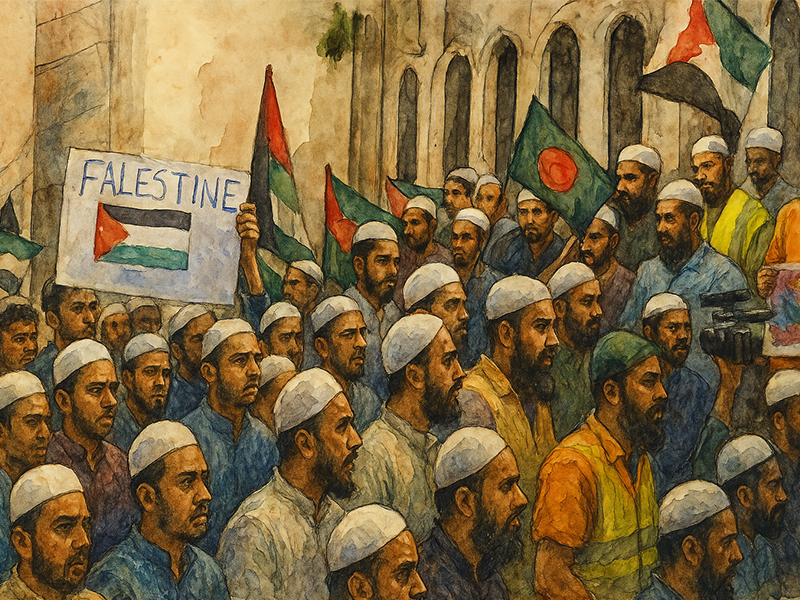
As images of devastation and loss from Gaza stream unfiltered across the world, more than 100,000 people filled Suhrawardy Udyan on Friday in what became not just a protest, but a moral reckoning. The “March for Gaza,” organized by the Palestine Solidarity Movement, was a sweeping cry for justice, echoing the conscience of a world that has watched, often in silence, as a genocide unfolds in real time.
This was not an ordinary political gathering. It was a human outpouring—an appeal from ordinary people in Bangladesh to global powers, religious leaders, and international institutions: act now, or be complicit.
Participants arrived from dawn, many on foot, chanting slogans and waving the Palestinian tricolour. By noon, the 95-acre grounds were overflowing. Some climbed trees to witness the moment. The atmosphere, heavy with grief, ignited by solidarity, was electric. The keffiyeh—once a symbol of resistance, now an emblem of survival—wrapped the shoulders of young and old alike.
What they were responding to is no longer in question. The systematic destruction of Gaza, the relentless killing of civilians, and the erasure of an entire people’s future have been broadcast on every screen. Children pulled from rubble. Hospitals turned to ruins. Ceasefires promised and broken. In Dhaka, the response was unflinching: this is genocide.
The protest culminated in a tearful prayer led by Mufti Abdul Malek, Imam of the National Mosque. His voice cracked as he asked for divine protection for Palestinians and pleaded for the world’s leaders to awaken from their indifference. The crowd sobbed and whispered “Ameen” in unison—not just out of faith, but shared anguish.
From the stage, Mahmudur Rahman, editor of Amar Desh, read a declaration that demanded international legal action against Israel at the International Criminal Court. It called for a return to pre-1967 borders, recognition of East Jerusalem as the capital of Palestine, and a total severance of diplomatic ties with Israel by Muslim-majority countries.
Political figures, artists, poets, and social media voices stood side by side. Their message was unified: silence is no longer neutrality—it is betrayal.
In a world saturated by real-time evidence of suffering, where every bomb dropped is caught by a camera, this rally was more than symbolic. It was necessary. It stood in defiance of complicity and demanded that history record who spoke out, and who remained quiet.
The people of Dhaka spoke. And they spoke for millions whose voices are being buried under rubble.