


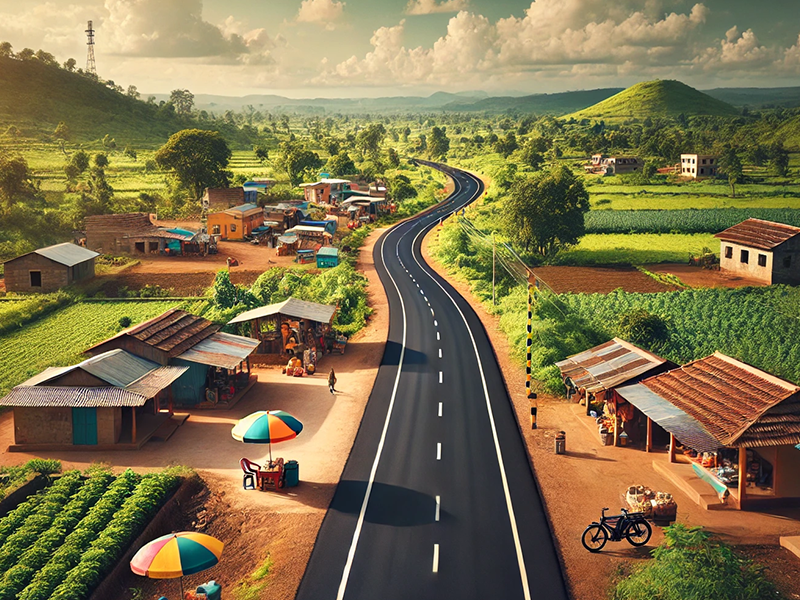
Since 2000, India has been undertaking one of the most ambitious rural infrastructure projects in the world, connecting thousands of villages with all-weather roads. The Pradhan Mantri Gram Sadak Yojana (PMGSY) was launched to reduce rural isolation, making it easier for millions of people to access schools, hospitals, and markets. Over the past two decades, the country has added more than 773,000 km of surfaced rural roads, drastically improving connectivity. The World Bank has also played a significant role, investing $2.1 billion into the project and funding 48,000 km of roads, directly benefiting 19,000 habitations across nine states. The rapid expansion has transformed rural India, making once-remote villages part of a growing network of economic and social opportunities.
For years, poor roads meant villagers had to travel long distances on foot, use unreliable transport, or simply stay home. In places like Rajasthan, Jharkhand, and Meghalaya, villagers relied on dirt roads that became impassable during the rainy season. Farmers struggled to bring their produce to markets, students found it difficult to attend school, and medical emergencies often turned into tragedies due to the lack of accessible healthcare. With the construction of all-weather roads, these challenges have begun to disappear. Farmers in Meghalaya, who once carried banana bunches on their backs for miles, can now transport their entire produce in pick-up vans, doubling their weekly income. Young men in Jharkhand, who were once limited to seasonal agricultural work, now travel to nearby cities for factory jobs, providing stable incomes for their families. In Rajasthan, increased road access has led to full school enrollment, with more students now pursuing higher education.
The benefits extend beyond transportation. Roads have played a crucial role in women’s empowerment. Research has shown that in villages with new roads, women no longer require permission to leave their homes as often, and rates of domestic violence have decreased. Healthcare has also improved dramatically. Ambulances can now reach homes directly, reducing the need for makeshift transport for pregnant women and the elderly. In many villages, maternal health care has improved, leading to lower miscarriage rates and increased childhood vaccinations. Rural families who once relied on traditional medicine or distant clinics can now access proper healthcare facilities in nearby towns.
Despite these achievements, challenges remain. Corruption in road construction has led to poor-quality roads in some areas, and many older roads suffer from a lack of maintenance. Some roads have been built with substandard materials, and local politicians often prioritize projects in areas where they have more voters. Furthermore, while rural roads have improved mobility and access to services, they have not yet significantly increased rural income levels. Some researchers suggest this could be because the full economic impact of connectivity takes years to materialize. Others believe that while incomes have risen for those who have migrated to cities, the numbers do not reflect improvements for those who remain in villages.
The government is now focusing on maintaining and expanding the network. A new phase of PMGSY, approved in late 2024, aims to construct 62,500 km of additional roads by 2029. Greater oversight measures, including community participation in planning and monitoring, are being introduced to tackle corruption and ensure road quality. Innovative contracts are engaging local communities and women’s self-help groups in road maintenance, strengthening the program’s long-term impact.
While roads alone cannot solve all of rural India’s challenges, their impact is undeniable. Schools, hospitals, and markets are no longer out of reach. Social norms are shifting, with women traveling more freely and students staying in school longer. The rural economy, long disconnected from urban centers, is becoming part of a more integrated system. For millions of Indians, these roads are more than just infrastructure—they are pathways to a better future.